Microgeneration.
Having seen the immediate results of the first installation and the reduction of energy we are not demanding from the national grid , we have decided to add another 2.08KWh system.
This was not an automatic option as there is a maximum 16 amps per phase and equates to a limit of 3.5kWh that can be produced on a domestic premise, and so the installers had to apply for a G83 exemption to the network providers (Suppliers of Electrical power in this area South East) which in our case is EDF. However when approached by the installation Director who supplied the appropriate paper work they approved the increase in generation, and the work went ahead.
Another point of which you should be aware is that the Grant which was allowed on the first phase installation is not available for the second, A maximum grant of £2500 is available per household for any given system type in this case photovoltaic, which we have already received.
.JPG) This is a photographic mock of what the panels should look like when sited on the this roof section
It is by far the best roof for the extra panel's as it is exposed to the direct sunlight for the best part of the day.
This is a photographic mock of what the panels should look like when sited on the this roof section
It is by far the best roof for the extra panel's as it is exposed to the direct sunlight for the best part of the day.
The extra panels will be sited on the roof either side of our present solar domestic system, which is very favourably positioned facing South, South East, 14 panels going on one section of roof and the remaining two being fitted along side the first installation. The 16 extra panels in total producing a theoretical output of 2.08KWh.making our total theoretical generation 4.16KWh. It is hoped that the majority of this extra power will be exported to the national grid.
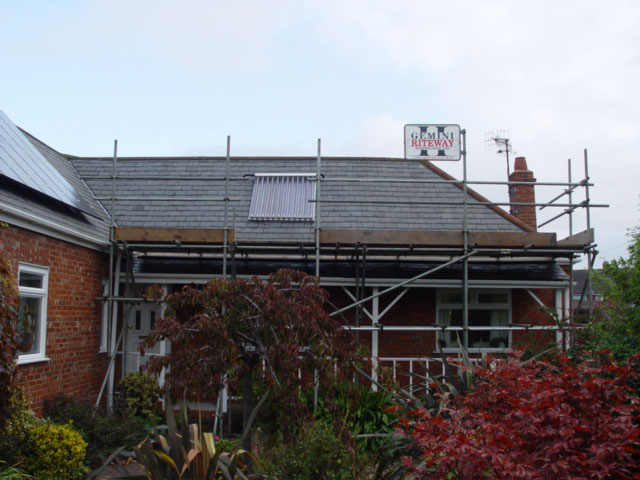 1st November 2008
This project is already under way with the scaffolding being erected ready for the installation to commence on Monday the 3rd of November.
The scaffolding company Gemini Riteway, Lewis, Sussex Depot, have done a great job in ensuring the the slates on the overhang of the balcony are protected by the position of the scaffold and boards precisely as I requested.
This section of the roof was damaged by the Company installing the Solar Domestic Hot water system, because they had not used scaffolding as promised.
It was also initially rejected for the first phase, Photovoltaic system because of the difficulty of access and the fact that it would not cater for all 16 panels forming the 2.08KWh system, the surplus two panels as mentioned above will be fitted along side the panels on the other roof.
In this instance we anticipate the all of the energy produced will be exported to the national grid, along with the unused energy from the first installation (1st installation.)
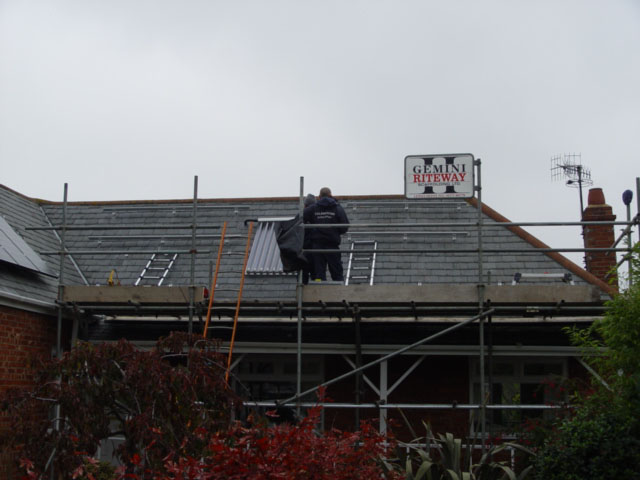
November 3rd 0750 and the team are on site and getting organised, it's a cold and blustery day as well as threatening rain so the work on the roof is quickly underway.
As Well as a lot of unseen work in the loft area, the securing bolts and brackets have been fitted and the supporting framework mounted ready for the panels.
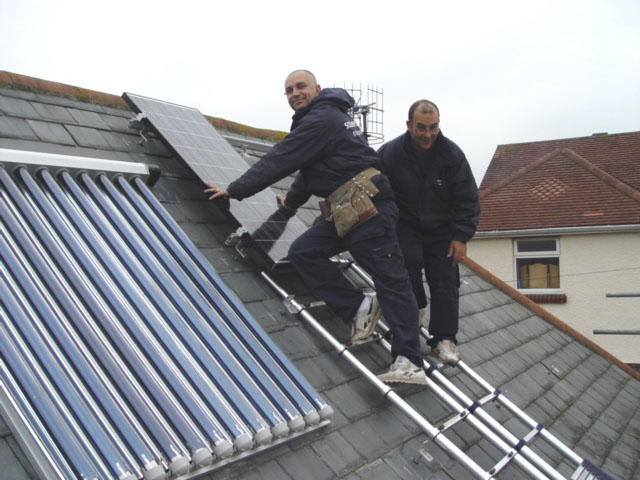
The rain has just about held off although we have had a few spots and having completed all the preparatory work the first of the new panels was fitted.
The team of two men worked continuously almost without stopping for the whole of the first day and in to the early afternoon of the second day.
The end product and workmanship being up to the standard of the first installation.
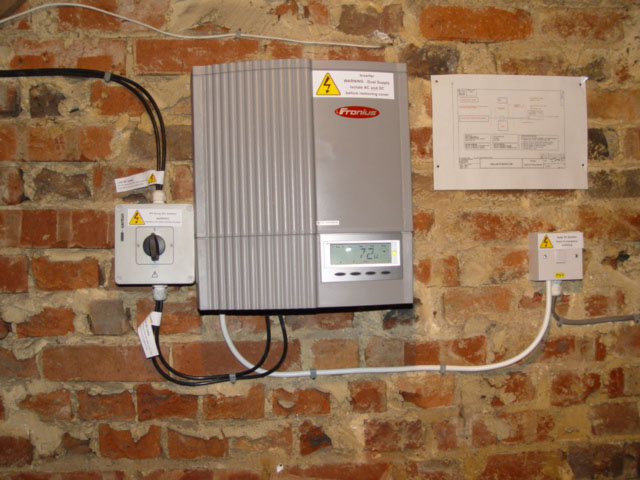 The installations director adjusted and organised the existing and new equipment to keep the costs down and to get the best from the two installations.
This was mainly due to the two extra panels being added to the earlier system which then required a higher rated Inverter this action was required because there was insufficient space for 16 panels on the roof employed for the second installation.
This higher rated inverter still required the separate D.C. isolator
This raises a point about planning.
If you intend or are even considering solar Domestic hot water system or/and a photovoltaic systems consider where best to site the one to avoid causing problems to the other!
I make this point purely on the basis that at the time we purchased Solar Domestic Hot water system we had not considered having photovoltaic.
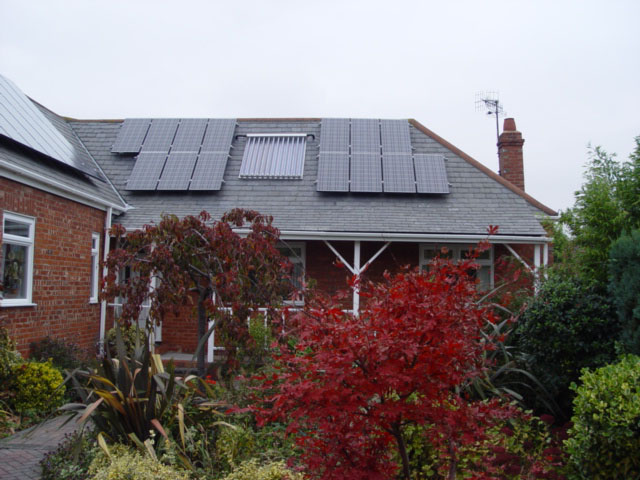 As a result the solar thermal Domestic then caused the installers more work when it came to install the 2nd phase of photovoltaic, albeit we are very pleased with the way it has worked out and feel that it is as neat as it could possibly look. Certainly more functional than satellite dishes all over buildings.
As our first image on this page shows we did know what it would look like, by transposing panels from the first phase onto the second roof using the computer.
Compare the two images and you will see very little difference.
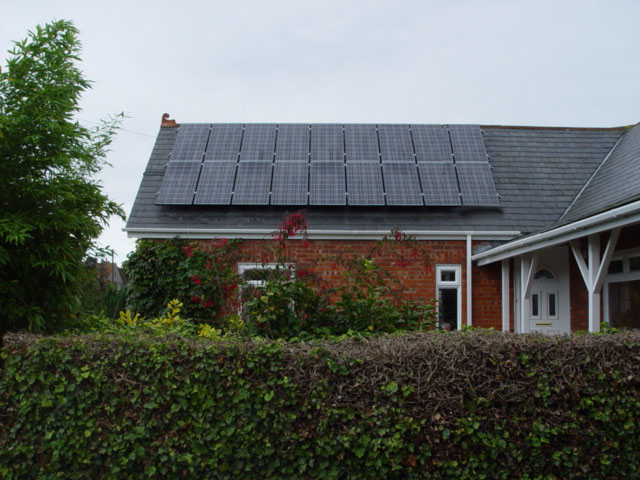 However there was insufficient room to site all 16 panels due to the Solar Thermal panel and so two panels where added to the first phase installation, again the installation team going the extra mile to satify the customers requirements.
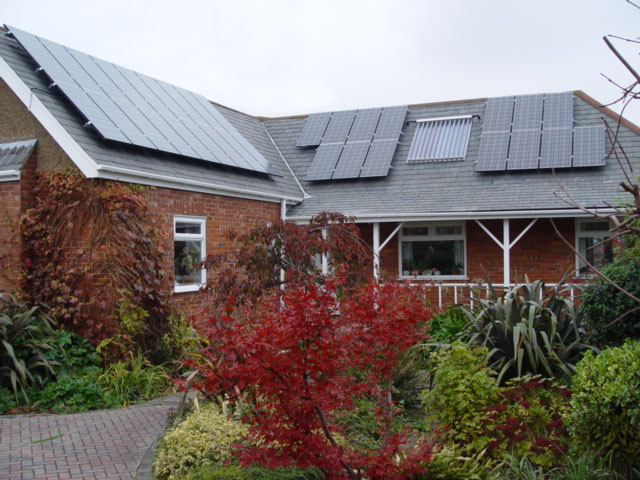
The two systems marry in very well with the colour of the slate and we are pleased with the way it looks.
Albeit we are suffering the dullest of weather in the South of England at present 4,5,6,/11/08 and so we have not as yet seen the benefits of the combined systems.
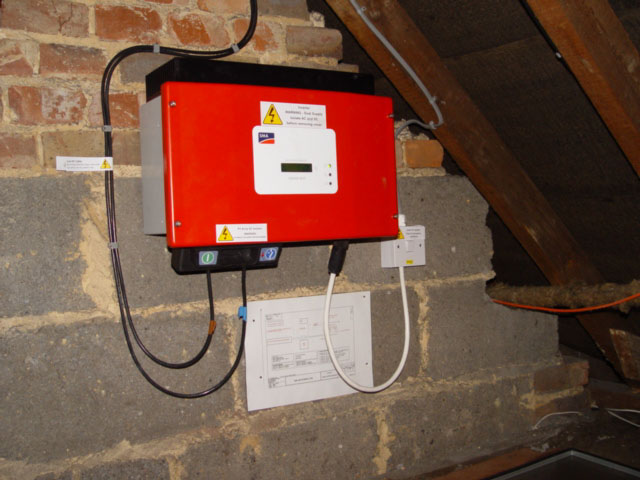
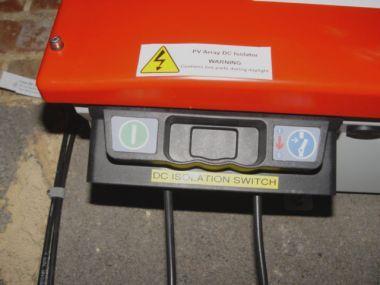
Even when the external work was done , work of course continued in the property. The 2nd inverter which was replaced by the new higher rated inverter was now used on the new installation.
It is interesting to not that in this case the separate D.C. isolator was not required, isolation being achieved by using the isolator/switch on the inverter itself.
The inverter was fitted as close to the system panels as possible to reduce the loss of power through the cable runs.
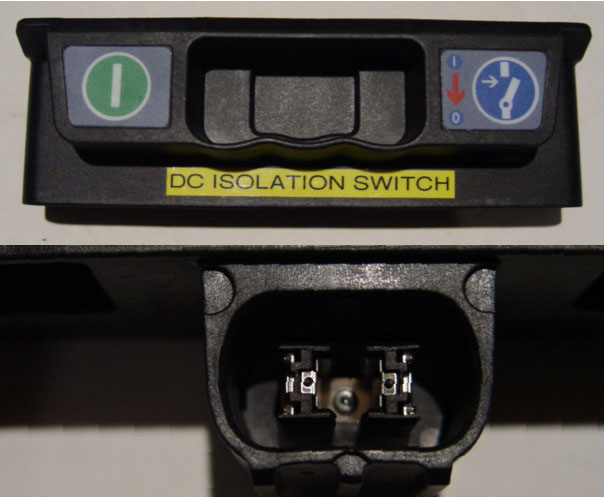
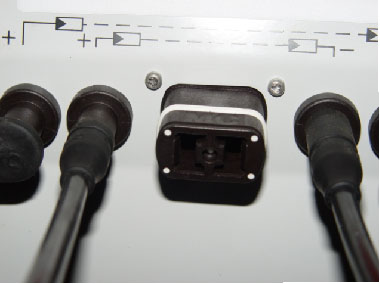
The isolation of the above inverter is now carried out by removing the contact breaker which locates at the bottom of the unit.
When replacing, the central plug is aligned with the plug and pushed firmly home until fully housed.
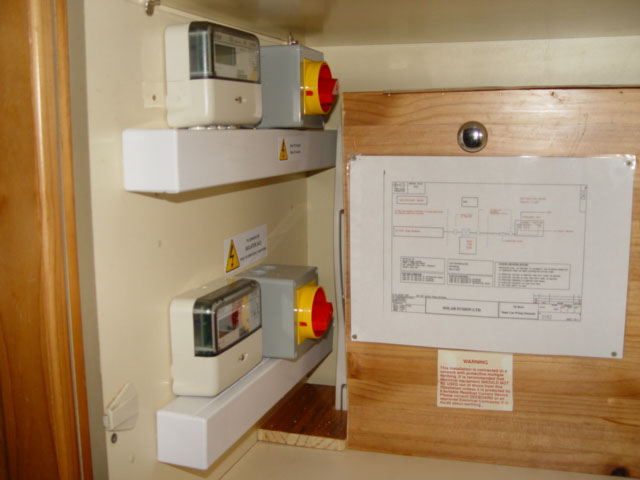
An additional Total generation meter was installed along with another A.C. isolator switch being connected to the new consumer unit fitted with the first phase one installation.
The reason for what appears to be a doubling up of equipment is due to the fact that the two roof areas are exposed to the sun for different periods of the day, as an instance the roof area on which phase 1. was located on the 30th of July 2008 was exposed to sunlight from 0745 until 1645hrs. and then remained in shade for the rest of the day light hours,
The roof area on which phase 2. has been located was exposed almost entirely from 1015 -until 1800hrs.with total shade of both roof areas by 1930hrs
Therefore if the two systems phase 1 & 2 had been connected up to the same inverter the total generation of the combined systems would have been reduced as a result of one being in shade at a different time period to the other and cable runs from the solar panels would have been much longer resulting in power loss.
The times and various roof exposure to direct sunlight was undertaken on the 30/07/08 in anticipation of the solar photovoltaic being purchased.
(The longest day in the year 2008 was the 21st June. which is relevant when making your calculations and roof exposure to sunlight.)
This 2nd installation will attract ROC's (see page 1)which will be managed by Southern Energy.
Update, Both systems will be transferred to the FITs scheme as of the 1.4.2010
 New consumer unit sensitivity
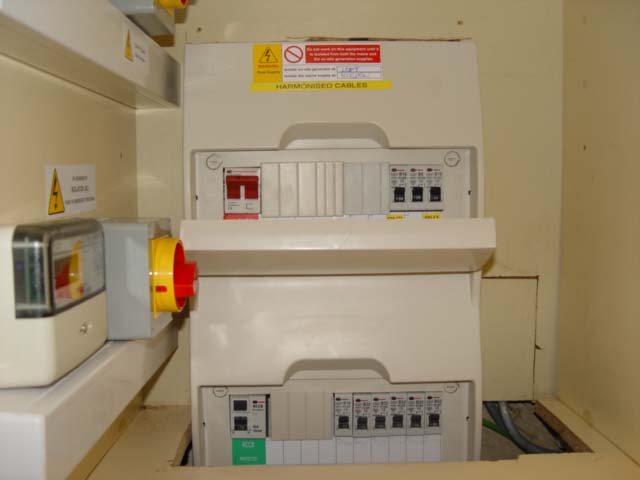
I mentioned earlier that as part of the installation we had to have a New Consumer unit. Although this is required to be fitted as part of the upgrade to the electrics, there are disadvantages.
We have found that the breakers (Electrical Contacts/switches ) in the system are so sensitive that even a light bulb blowing (element breaking/burning out) can cause the LCD breaker to trip thereby cutting the power off, which is by no means convenient.
The system is working correctly, but as consumer units are usually in dark cupboards or dark corners you do as the householder need a lamp handy and also need to be familiar with your New Consumer Unit, and layout, if you are going to be able to trip the relevant breakers back to recover lighting/power.
I was also found that not only the lighting-circuit breaker had opened, cutting off power to the lighting circuit but the main breaker had also opened/breaking all power to the building.
If this is in day light hours then you may have to turn OFF the inverter switch's (Red breakers switch near consumer unit) before you attempt to re-make (Turn On) the consumer units breakers.
Having established a connection by tripping the open breakers to the closed/ON position, only then turn the Inverter (red switch )back to the ON position.
Where you have more than one inverter, Undertake this procedure so as to allow allow each inverter to fully start up (allow 2 minutes) before turning on the next and so on.
This reduces the loading on the consumer unit and the breakers will remain closed, thereby allowing all electrical circuits to remain closed and therefore live.
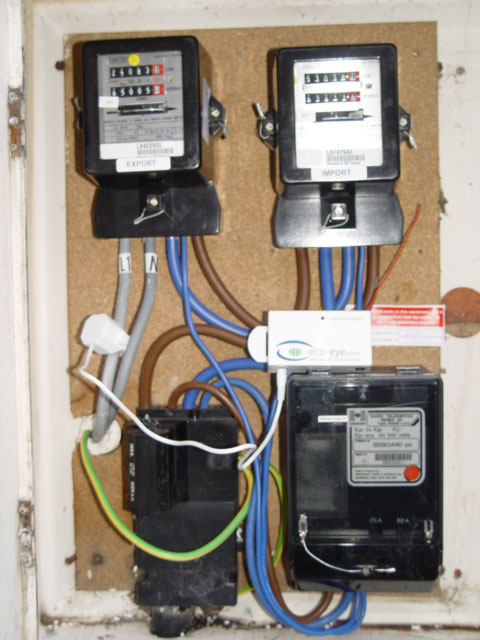
This photo shows our meter box and contents which is sited outside the building.
I'm please to be able to add that any surplus energy our systems now generate will be metered by the Export meter fitted by EDF on the 30th of October 2008.
As can be seen there are two meters old style, one being used for measuring/recording the exported energy to the national grid and the other for recording the imported energy (from the grid)
The small white box with white cable is the electronic transmitter for
the 'Eco-Eye' electricity monitors shown on the previous page, note the clamp which is easily clipped to the live feed coming into the property, it is this that communicates the information the the portable monitor within the building.
So what's all this cost
I was asked what this had all cost, I won't disclose the figures, but simply add that if our investment will help make the World a cleaner place for our Grand Children and their children, then it has been worth every penny.
We have enjoyed our lives and continue to do so, our aim now is to try and help conserve what is left of the Worlds resources and we hope that many of you with follow us and help make this World a greener place for those that follow.
I would like to thank the team who have done a superb job, and although their work is guaranteed for 3 years I don't anticipate having to call on them. The panels on the other hand are guaranteed for twenty years, all I need to do now is find out if the warrantee is transferable, as I doubt if I will be here in the year 2028 as I would be 97, coming ninety eight. Of course I can but hope!
Thank you for reading these pages and I hope it has helped you understand the photovoltaic system and requirements and if you were considering an installation that it has swung your decision in favour of green energy.
Just before I log off this page.
the photovoltaic systems mentioned on the two pages have now generated just under 8763KWh of energy,(3/11/10) this is enough power to light 87620 100 watt light bulbs for one hour and even more if low energy bulbs are used. I think you would agree that is a lot of power, so just how many of Blackpool's light bulbs are powered by green energy? For the year 2008 the following facts are available:-
1. Electricity consumed totals 960,000 units(KWh) at an approximate cost of £50,000.)
2. There are an amazing one million lamps in various types and styles.
3.There are more than 5,000 floodlights and spotlights.
How many of these are lit by photovoltaic energy? (Green Energy) After all they are in a much better financial position than we are to install the necessary equipment and they don't now need planning consent to do it.
A question we should perhaps ask ourselves before jumping in our fuel hungry cars to go and see the pretty lights!
In the year 2008 it's expected that the army of visitors will spend more than £275 million while visiting the resort during the Lights. so where is all the money going if not into green energy?
What a challenge for the City Council/Management of Blackpool to set an example and power all these lights by solar photovoltaic energy or green energy, wind power, before the year 2012., This would demonstrate to the expected visitors that this country is serious about green energy. Figures taken from :-www.blackpool-illuminations.net/
Management of 'Imported Energy' Electricity Bills. Tariffs for the provision of electricity are varied and complex and to get the best for your money you need to discuss this in depth with your Energy provider
Also as of the 1/4/10 you do not need to use the same company for the provision of and selling of your generated power.
If your system is post 15/07/10 then the figures are pre-set and will be the same for all energy companies.
However the energy act 1/4/2010 secondary legislation makes provision for generators to sell their surplus energy on the open market, this in effect means that you MAY be able to get more than the 3p offered under FITs for your exported energy.
However if you intend doing this you will require an Export meter which does not form part of your PV system. Installing such a meter may be costly and can normally only be undertaken by the network provider for your area in our case EDF.
Your supplier of energy will be able to tell you who the network provider for your area is , this varies for different parts of the Country.
Although the price for exported KWh of energy is set at 3p at present and it appears most Companies are sticking to that minimum price, it is hoped that in the future the open market price will increase. only time will tell.
If on the other hand you haven't got an export meter then you will be paid for the energy recorded on your TGM once you are registered for the FITs scheme. This fiance comes from the energy Companies themselves and is not sponsored in anyway by the Government although they would like you to believe it is.
We are on an Economy 7 tariff, we do not have gas and therefore prior to fitting solar thermal water heating all our hot water was heated by emersion heater, in the winter that consumed 3KW per hour, albeit was partially heated by our solid fuel boiler.
However despite installing a larger more efficient boiler it's been so cold the last two winters 2008/9 9/10 that we have used the boiler for heating the radiators alone which has kept the property at an even temperature, but as a result we have had to supplement the Solar Thermal to get adequate supplies of hot water for domestic needs, by using the emersion heater for short periods in the of peak E7 periods.
I have just looked hard at the tariffs paid for Imported Electricity by my provider Southern Electric, a wise choice?
One thing that came to light was that this was only a wise move if your demand in the off peak E7 Periods exceeded 1/5th of your total demand for the 24 hour period.
this was because you pay more for your units (KWh ) of electricity used during the peak hours than you would if you were on a standard Domestic tariff
I would also add that this account is a NO standing charge account when you have PV installed dependent on the size of your system the standing charge out any benefits so look carefully at what you are paying.
The E7 rates apply to the 24 hour clock GMT as follows :-
2231-0030 Night rate
0031-0230 Day rate
0231-0730 Night rate
0731-2230 Day rate
You will need to avoid the 1 hour adjustment for British Summer Time
If you have the old style meters as shown in my photographs then don't alter in house time clocks, they will remain an hour out of line with BST and you will still get the low night rate for running appliances such as washing machines etc.
So Economy seven is Seven hours at low rate (night Rate )tariff but isn't as straight forward as many of us may think. With the result than when setting up time clocks, so as to benefit for the E7 (low rate) we need to make sure the time clocks are set so as the avoid the Normal (day time) tariff, which for some reason suddenly appears in the early hours of the morning.
one of the alternatives to E7 is the domestic rates although again you need to discuss this with your provider and there are all sorts of discounts, reading your own meter, direct debits and so on so do your home work to get the best for your cash.
Domestic tariff, Southern Electric (GO DIRECT 3)
First 1000(KWh) Per year 15.88, remaining units, Day 10.88p & Night 4.43p 24/7
So if you have or are thinking about fitting solar energy you need to take these details into account . For instance in the summer months our demand on the national grid will be minimal, as the solar will kick in during the day light hours, our night demand will continue from the grid as solar photovoltaic and solar hot water will not generate power or produce hot water at night.
Wind energy, that's different again but we are not involved with that at present.
So you need to calculate carefully when working these figures out if you are not going to pay more for you power than you need.
I am currently taking daily readings of the meters installed on our systems and that should form at the end of the year a good estimate of our energy demands be it day or night. See pages page 3 Page 5
Currently our night time demand is about 40 per cent of our total demand from the grid, I'm certain this figure will increase as we approach the longer & warmer days of spring and summer when the photovoltaic systems will perform for longer hours and the water in our storage tank reaches higher temperatures each day.
. Things Have moved on since 2009
Well of course things have moved on since I added that information to the page in 2009 with the Government of the day moving the goal posts without any consideration for those that had already committed large sums of money to green energy.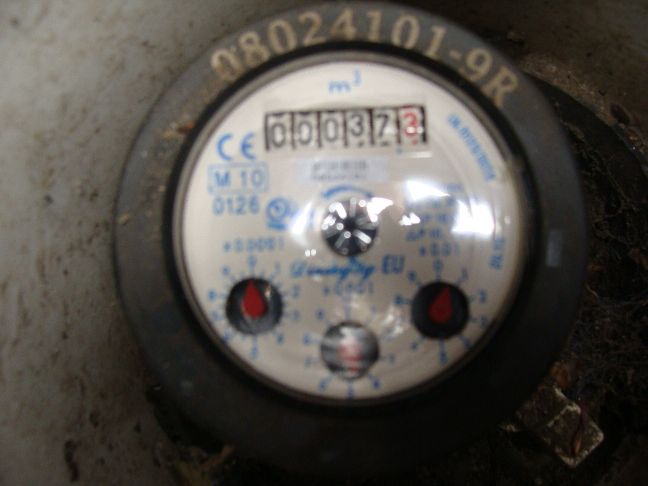
However we will survive even though the income from the solar has been drastically cut we being a pre- 15/07/09 installer.
We have taken steps to alleviate some of the loss by for instance having a water meter fitted, this is done free of charge and as far as I can see at present will reduce our water rates by as much as £100 PA, even though at present the South Coast is very dry and we are having the water the vegetable plot.
However before you jump to do the same look at the numbers in your family and look at your water bill as it stands at present.
Southern Water prices
Initially water looks cheap @£0.93p a Cubic meter (1 tonne)However it costs another £1.77 per cu meter or tonne to dispose of it back to the water company, the amount of water 'Returned to Sewer' in our case is 92.5% of the metered imported water, albeit far less than than is returned due to our large gardens and pond which this year has needed topping up almost daily due to the evaporation. None of which of course is 'Returned to Sewer', the same applies to children's inflatable swimming pools which are normally emptied onto the glass or garden area and yes the larger ones hold hundreds of litres.
On top of that combined figure you have of course the normal standing charges for both Water Supply & Waste Water disposal.
In addition you may dependent on the layout of your guttering have a service water drainage charge plus a charge for Highway drainage which we all have to pay.
You can if your guttering goes to your own soak-a-ways, claim a rebate for the surface water drainage charge which in our case would be £22.00 PA
So before you jump, do your homework and using your water companies figures calculate the costs involved, but do remember in the long term we will all finish up with water meters, and if you move into a New or Used house now it will be fitted with a water meter.
How can you get the best from your investment?
Now with the FITs payments having kicked in do your washing on sunny days during the day time, this way you are using energy produced or at least subsidised by your own system AND for which you will be still be paid.
I was surprised to see that during the Low E7 period since changing to British summer time our systems have generated 68KWh, So careful management of your solar system and use of domestic appliances can bring rewards.
Maintenance/Defects
Up and until the 22.11 2017 all I have done is clean the Solar panels using chimney type rods and a brush, this has ensured that the panels are clean producing maximum energy. Living by the sea can have benefits however sea gulls fouling the panels is not one of them.
On the 22nd November 2017 I noticed that my PV.2. installation was not producing the amount of energy expected when compared with my PV.1. installation.
This was only noticed because I take daily readings and put them on my web site.
I now have reason to believe that the total generation meter (TGM) of my second installation has gone defective and I will have to get it replaced. I will put further information on this page when the new meter is fitted.
The inverter for PV.2 shows me in the display that 4,65 KWh was generated today 25th November, however the total generation meter reading only increased by 0.2 of a KWh so obviously there is a problem.
However this does raise the question when would it have spotted had I not been taking daily readings? My advise to owners would be to check your TGM from time to time and ensure that the reading is increasing albeit only a small amount in the winter months dependent on the size of your system.
If like me you have two TGM's then you can compare the readings.
It is worth remembering that the Inverters will only display during daylight hours whereas the TGM should display the last recorded reading 24 hours a day. In the case of my suspect meter it displays 8888888888 sometimes and the last recorded reading at other, the meter has also clocked backwards several times reaching 16215.6 earlier in the day, it currently shows 16215.3.
Had it been working correctly today it would have recoded 4.6KWh as recorded at the Inverter. However the reading on the TGM is what is provided to OFGEM via the energy company you selected to manage you PV account and therefore you would not be paid for energy produced but not recorded on your TGM.
Should you suffer a failure Take photographs of the last reading displayed on the defective meter and the reading displayed on the new meter, these will need to be provided to your PV energy company so that they can record the reading and the serial numbers of the meters involved.
It would be prudent to put a note in your PV files indicating when the meter was changed along with the copies of the meters photographed along with the proof that your PV energy company was informed and when.
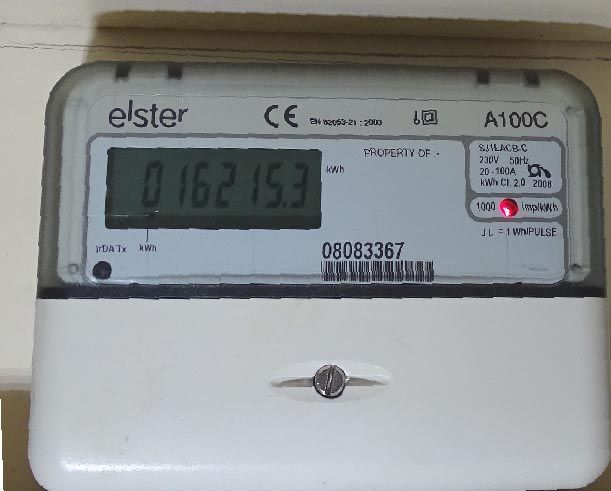
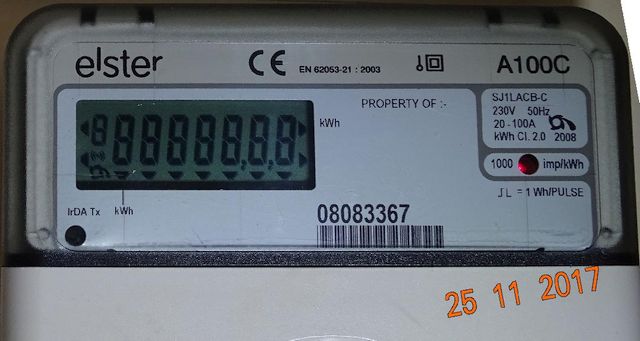
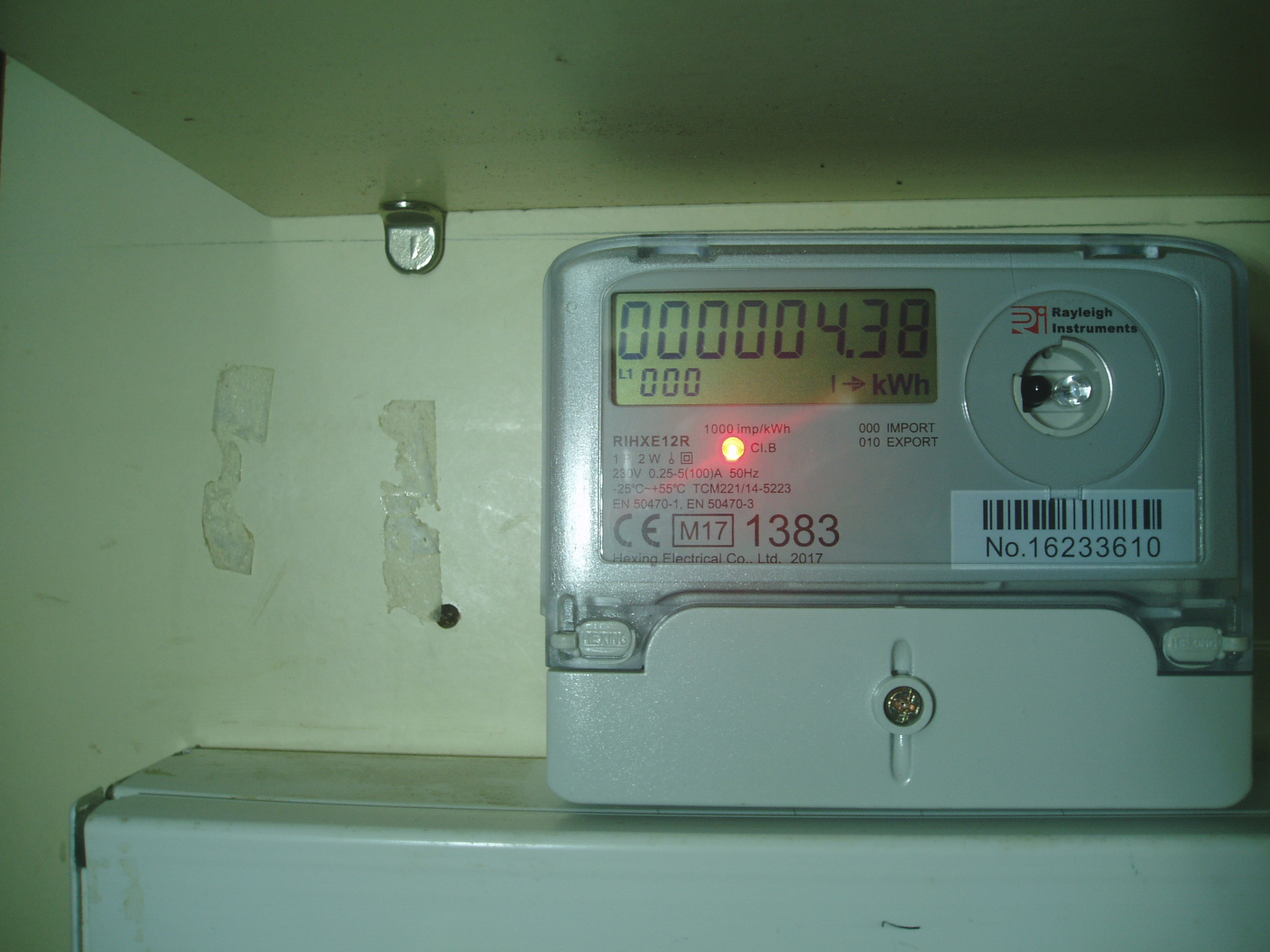
The suspect meter was replaced with a Rayleigh TGM and the fault is resolved This TGM was available off the shelf from Sunstore a well established solar energy company in Goring Worthing West Sussex whose staff were most helpful www.Solarstore
I did contact Elster electrical but was told the original; meter was guaranteed for two years and they recommended replacing the elster with a Rayleigh Meter so obviously the Elster TGM is no longer available.
My final job was to inform the energy company who I'm contracted to make the fits payments, sending them both a photograph of the last reading on the old meter and a photo of the new meter, make and serial number.
Remember to take a photo of the old meter before it is disconnected , there is no display once it is disconnected
How else can I save money.
Dialling 0845 0844, 0870 and similar numbers can cost you more than the cost of a local or regional telephone call, and if you on a single monthly tariff contract with your telephone internet/provider, regional and local calls would be included in that tariff, but you will have to pay extra on you monthly bill if you dial these premium rate numbers as well as mobiles So to avoid these premium rate numbers, visit this site and look for alternative numbers, a lot of companies also have 0800 free call numbers but don't advertise them, this site will give you those numbers Alliance & Leicester is just one example:-
www.say no to 0870.com another tip is that companies that don't advertise a regional UK number quite often give a number when calling from overseas, just delete the 0044 and insert just one '0' in front of the number shown, that will be a regional number for that company
Beat them at their own game and same ££££££
This was not an automatic option as there is a maximum 16 amps per phase and equates to a limit of 3.5kWh that can be produced on a domestic premise, and so the installers had to apply for a G83 exemption to the network providers (Suppliers of Electrical power in this area South East) which in our case is EDF. However when approached by the installation Director who supplied the appropriate paper work they approved the increase in generation, and the work went ahead.
Another point of which you should be aware is that the Grant which was allowed on the first phase installation is not available for the second, A maximum grant of £2500 is available per household for any given system type in this case photovoltaic, which we have already received.
This is a photographic mock of what the panels should look like when sited on the this roof section
It is by far the best roof for the extra panel's as it is exposed to the direct sunlight for the best part of the day.The extra panels will be sited on the roof either side of our present solar domestic system, which is very favourably positioned facing South, South East, 14 panels going on one section of roof and the remaining two being fitted along side the first installation. The 16 extra panels in total producing a theoretical output of 2.08KWh.making our total theoretical generation 4.16KWh. It is hoped that the majority of this extra power will be exported to the national grid.
1st November 2008 This project is already under way with the scaffolding being erected ready for the installation to commence on Monday the 3rd of November.
The scaffolding company Gemini Riteway, Lewis, Sussex Depot, have done a great job in ensuring the the slates on the overhang of the balcony are protected by the position of the scaffold and boards precisely as I requested.
This section of the roof was damaged by the Company installing the Solar Domestic Hot water system, because they had not used scaffolding as promised.
It was also initially rejected for the first phase, Photovoltaic system because of the difficulty of access and the fact that it would not cater for all 16 panels forming the 2.08KWh system, the surplus two panels as mentioned above will be fitted along side the panels on the other roof.
In this instance we anticipate the all of the energy produced will be exported to the national grid, along with the unused energy from the first installation (1st installation.)
November 3rd 0750 and the team are on site and getting organised, it's a cold and blustery day as well as threatening rain so the work on the roof is quickly underway.
As Well as a lot of unseen work in the loft area, the securing bolts and brackets have been fitted and the supporting framework mounted ready for the panels.
The rain has just about held off although we have had a few spots and having completed all the preparatory work the first of the new panels was fitted.
The team of two men worked continuously almost without stopping for the whole of the first day and in to the early afternoon of the second day.
The end product and workmanship being up to the standard of the first installation.
The installations director adjusted and organised the existing and new equipment to keep the costs down and to get the best from the two installations.This was mainly due to the two extra panels being added to the earlier system which then required a higher rated Inverter this action was required because there was insufficient space for 16 panels on the roof employed for the second installation.
This higher rated inverter still required the separate D.C. isolator
This raises a point about planning.
If you intend or are even considering solar Domestic hot water system or/and a photovoltaic systems consider where best to site the one to avoid causing problems to the other!
I make this point purely on the basis that at the time we purchased Solar Domestic Hot water system we had not considered having photovoltaic.
As a result the solar thermal Domestic then caused the installers more work when it came to install the 2nd phase of photovoltaic, albeit we are very pleased with the way it has worked out and feel that it is as neat as it could possibly look. Certainly more functional than satellite dishes all over buildings.As our first image on this page shows we did know what it would look like, by transposing panels from the first phase onto the second roof using the computer.
Compare the two images and you will see very little difference.
However there was insufficient room to site all 16 panels due to the Solar Thermal panel and so two panels where added to the first phase installation, again the installation team going the extra mile to satify the customers requirements.The two systems marry in very well with the colour of the slate and we are pleased with the way it looks.
Albeit we are suffering the dullest of weather in the South of England at present 4,5,6,/11/08 and so we have not as yet seen the benefits of the combined systems.
Even when the external work was done , work of course continued in the property. The 2nd inverter which was replaced by the new higher rated inverter was now used on the new installation.
It is interesting to not that in this case the separate D.C. isolator was not required, isolation being achieved by using the isolator/switch on the inverter itself.
The inverter was fitted as close to the system panels as possible to reduce the loss of power through the cable runs.
The isolation of the above inverter is now carried out by removing the contact breaker which locates at the bottom of the unit.
When replacing, the central plug is aligned with the plug and pushed firmly home until fully housed.
An additional Total generation meter was installed along with another A.C. isolator switch being connected to the new consumer unit fitted with the first phase one installation.
The reason for what appears to be a doubling up of equipment is due to the fact that the two roof areas are exposed to the sun for different periods of the day, as an instance the roof area on which phase 1. was located on the 30th of July 2008 was exposed to sunlight from 0745 until 1645hrs. and then remained in shade for the rest of the day light hours,
The roof area on which phase 2. has been located was exposed almost entirely from 1015 -until 1800hrs.with total shade of both roof areas by 1930hrs
Therefore if the two systems phase 1 & 2 had been connected up to the same inverter the total generation of the combined systems would have been reduced as a result of one being in shade at a different time period to the other and cable runs from the solar panels would have been much longer resulting in power loss.
The times and various roof exposure to direct sunlight was undertaken on the 30/07/08 in anticipation of the solar photovoltaic being purchased.
(The longest day in the year 2008 was the 21st June. which is relevant when making your calculations and roof exposure to sunlight.)
This 2nd installation will attract ROC's (see page 1)which will be managed by Southern Energy.
Update, Both systems will be transferred to the FITs scheme as of the 1.4.2010
New consumer unit sensitivity I mentioned earlier that as part of the installation we had to have a New Consumer unit. Although this is required to be fitted as part of the upgrade to the electrics, there are disadvantages.
We have found that the breakers (Electrical Contacts/switches ) in the system are so sensitive that even a light bulb blowing (element breaking/burning out) can cause the LCD breaker to trip thereby cutting the power off, which is by no means convenient.
The system is working correctly, but as consumer units are usually in dark cupboards or dark corners you do as the householder need a lamp handy and also need to be familiar with your New Consumer Unit, and layout, if you are going to be able to trip the relevant breakers back to recover lighting/power.
I was also found that not only the lighting-circuit breaker had opened, cutting off power to the lighting circuit but the main breaker had also opened/breaking all power to the building.
If this is in day light hours then you may have to turn OFF the inverter switch's (Red breakers switch near consumer unit) before you attempt to re-make (Turn On) the consumer units breakers.
Having established a connection by tripping the open breakers to the closed/ON position, only then turn the Inverter (red switch )back to the ON position.
Where you have more than one inverter, Undertake this procedure so as to allow allow each inverter to fully start up (allow 2 minutes) before turning on the next and so on.
This reduces the loading on the consumer unit and the breakers will remain closed, thereby allowing all electrical circuits to remain closed and therefore live.
This photo shows our meter box and contents which is sited outside the building.
I'm please to be able to add that any surplus energy our systems now generate will be metered by the Export meter fitted by EDF on the 30th of October 2008.
As can be seen there are two meters old style, one being used for measuring/recording the exported energy to the national grid and the other for recording the imported energy (from the grid)
The small white box with white cable is the electronic transmitter for
the 'Eco-Eye' electricity monitors shown on the previous page, note the clamp which is easily clipped to the live feed coming into the property, it is this that communicates the information the the portable monitor within the building.
So what's all this cost
I was asked what this had all cost, I won't disclose the figures, but simply add that if our investment will help make the World a cleaner place for our Grand Children and their children, then it has been worth every penny.
We have enjoyed our lives and continue to do so, our aim now is to try and help conserve what is left of the Worlds resources and we hope that many of you with follow us and help make this World a greener place for those that follow.
I would like to thank the team who have done a superb job, and although their work is guaranteed for 3 years I don't anticipate having to call on them. The panels on the other hand are guaranteed for twenty years, all I need to do now is find out if the warrantee is transferable, as I doubt if I will be here in the year 2028 as I would be 97, coming ninety eight. Of course I can but hope!
Thank you for reading these pages and I hope it has helped you understand the photovoltaic system and requirements and if you were considering an installation that it has swung your decision in favour of green energy.
Just before I log off this page.
the photovoltaic systems mentioned on the two pages have now generated just under 8763KWh of energy,(3/11/10) this is enough power to light 87620 100 watt light bulbs for one hour and even more if low energy bulbs are used. I think you would agree that is a lot of power, so just how many of Blackpool's light bulbs are powered by green energy? For the year 2008 the following facts are available:-
1. Electricity consumed totals 960,000 units(KWh) at an approximate cost of £50,000.)
2. There are an amazing one million lamps in various types and styles.
3.There are more than 5,000 floodlights and spotlights.
How many of these are lit by photovoltaic energy? (Green Energy) After all they are in a much better financial position than we are to install the necessary equipment and they don't now need planning consent to do it.
A question we should perhaps ask ourselves before jumping in our fuel hungry cars to go and see the pretty lights!
In the year 2008 it's expected that the army of visitors will spend more than £275 million while visiting the resort during the Lights. so where is all the money going if not into green energy?
What a challenge for the City Council/Management of Blackpool to set an example and power all these lights by solar photovoltaic energy or green energy, wind power, before the year 2012., This would demonstrate to the expected visitors that this country is serious about green energy. Figures taken from :-www.blackpool-illuminations.net/
Management of 'Imported Energy' Electricity Bills. Tariffs for the provision of electricity are varied and complex and to get the best for your money you need to discuss this in depth with your Energy provider
Also as of the 1/4/10 you do not need to use the same company for the provision of and selling of your generated power.
If your system is post 15/07/10 then the figures are pre-set and will be the same for all energy companies.
However the energy act 1/4/2010 secondary legislation makes provision for generators to sell their surplus energy on the open market, this in effect means that you MAY be able to get more than the 3p offered under FITs for your exported energy.
However if you intend doing this you will require an Export meter which does not form part of your PV system. Installing such a meter may be costly and can normally only be undertaken by the network provider for your area in our case EDF.
Your supplier of energy will be able to tell you who the network provider for your area is , this varies for different parts of the Country.
Although the price for exported KWh of energy is set at 3p at present and it appears most Companies are sticking to that minimum price, it is hoped that in the future the open market price will increase. only time will tell.
If on the other hand you haven't got an export meter then you will be paid for the energy recorded on your TGM once you are registered for the FITs scheme. This fiance comes from the energy Companies themselves and is not sponsored in anyway by the Government although they would like you to believe it is.
We are on an Economy 7 tariff, we do not have gas and therefore prior to fitting solar thermal water heating all our hot water was heated by emersion heater, in the winter that consumed 3KW per hour, albeit was partially heated by our solid fuel boiler.
However despite installing a larger more efficient boiler it's been so cold the last two winters 2008/9 9/10 that we have used the boiler for heating the radiators alone which has kept the property at an even temperature, but as a result we have had to supplement the Solar Thermal to get adequate supplies of hot water for domestic needs, by using the emersion heater for short periods in the of peak E7 periods.
I have just looked hard at the tariffs paid for Imported Electricity by my provider Southern Electric, a wise choice?
One thing that came to light was that this was only a wise move if your demand in the off peak E7 Periods exceeded 1/5th of your total demand for the 24 hour period.
this was because you pay more for your units (KWh ) of electricity used during the peak hours than you would if you were on a standard Domestic tariff
I would also add that this account is a NO standing charge account when you have PV installed dependent on the size of your system the standing charge out any benefits so look carefully at what you are paying.
The E7 rates apply to the 24 hour clock GMT as follows :-
2231-0030 Night rate
0031-0230 Day rate
0231-0730 Night rate
0731-2230 Day rate
You will need to avoid the 1 hour adjustment for British Summer Time
If you have the old style meters as shown in my photographs then don't alter in house time clocks, they will remain an hour out of line with BST and you will still get the low night rate for running appliances such as washing machines etc.
So Economy seven is Seven hours at low rate (night Rate )tariff but isn't as straight forward as many of us may think. With the result than when setting up time clocks, so as to benefit for the E7 (low rate) we need to make sure the time clocks are set so as the avoid the Normal (day time) tariff, which for some reason suddenly appears in the early hours of the morning.
one of the alternatives to E7 is the domestic rates although again you need to discuss this with your provider and there are all sorts of discounts, reading your own meter, direct debits and so on so do your home work to get the best for your cash.
Domestic tariff, Southern Electric (GO DIRECT 3)
First 1000(KWh) Per year 15.88, remaining units, Day 10.88p & Night 4.43p 24/7
So if you have or are thinking about fitting solar energy you need to take these details into account . For instance in the summer months our demand on the national grid will be minimal, as the solar will kick in during the day light hours, our night demand will continue from the grid as solar photovoltaic and solar hot water will not generate power or produce hot water at night.
Wind energy, that's different again but we are not involved with that at present.
So you need to calculate carefully when working these figures out if you are not going to pay more for you power than you need.
I am currently taking daily readings of the meters installed on our systems and that should form at the end of the year a good estimate of our energy demands be it day or night. See pages page 3 Page 5
Currently our night time demand is about 40 per cent of our total demand from the grid, I'm certain this figure will increase as we approach the longer & warmer days of spring and summer when the photovoltaic systems will perform for longer hours and the water in our storage tank reaches higher temperatures each day.
. Things Have moved on since 2009
Well of course things have moved on since I added that information to the page in 2009 with the Government of the day moving the goal posts without any consideration for those that had already committed large sums of money to green energy.
However we will survive even though the income from the solar has been drastically cut we being a pre- 15/07/09 installer.
We have taken steps to alleviate some of the loss by for instance having a water meter fitted, this is done free of charge and as far as I can see at present will reduce our water rates by as much as £100 PA, even though at present the South Coast is very dry and we are having the water the vegetable plot.
However before you jump to do the same look at the numbers in your family and look at your water bill as it stands at present.
Southern Water prices
Initially water looks cheap @£0.93p a Cubic meter (1 tonne)However it costs another £1.77 per cu meter or tonne to dispose of it back to the water company, the amount of water 'Returned to Sewer' in our case is 92.5% of the metered imported water, albeit far less than than is returned due to our large gardens and pond which this year has needed topping up almost daily due to the evaporation. None of which of course is 'Returned to Sewer', the same applies to children's inflatable swimming pools which are normally emptied onto the glass or garden area and yes the larger ones hold hundreds of litres.
On top of that combined figure you have of course the normal standing charges for both Water Supply & Waste Water disposal.
In addition you may dependent on the layout of your guttering have a service water drainage charge plus a charge for Highway drainage which we all have to pay.
You can if your guttering goes to your own soak-a-ways, claim a rebate for the surface water drainage charge which in our case would be £22.00 PA
So before you jump, do your homework and using your water companies figures calculate the costs involved, but do remember in the long term we will all finish up with water meters, and if you move into a New or Used house now it will be fitted with a water meter.
How can you get the best from your investment?
Now with the FITs payments having kicked in do your washing on sunny days during the day time, this way you are using energy produced or at least subsidised by your own system AND for which you will be still be paid.
I was surprised to see that during the Low E7 period since changing to British summer time our systems have generated 68KWh, So careful management of your solar system and use of domestic appliances can bring rewards.
Maintenance/Defects
Up and until the 22.11 2017 all I have done is clean the Solar panels using chimney type rods and a brush, this has ensured that the panels are clean producing maximum energy. Living by the sea can have benefits however sea gulls fouling the panels is not one of them.
On the 22nd November 2017 I noticed that my PV.2. installation was not producing the amount of energy expected when compared with my PV.1. installation.
This was only noticed because I take daily readings and put them on my web site.
I now have reason to believe that the total generation meter (TGM) of my second installation has gone defective and I will have to get it replaced. I will put further information on this page when the new meter is fitted.
The inverter for PV.2 shows me in the display that 4,65 KWh was generated today 25th November, however the total generation meter reading only increased by 0.2 of a KWh so obviously there is a problem.
However this does raise the question when would it have spotted had I not been taking daily readings? My advise to owners would be to check your TGM from time to time and ensure that the reading is increasing albeit only a small amount in the winter months dependent on the size of your system.
If like me you have two TGM's then you can compare the readings.
It is worth remembering that the Inverters will only display during daylight hours whereas the TGM should display the last recorded reading 24 hours a day. In the case of my suspect meter it displays 8888888888 sometimes and the last recorded reading at other, the meter has also clocked backwards several times reaching 16215.6 earlier in the day, it currently shows 16215.3.
Had it been working correctly today it would have recoded 4.6KWh as recorded at the Inverter. However the reading on the TGM is what is provided to OFGEM via the energy company you selected to manage you PV account and therefore you would not be paid for energy produced but not recorded on your TGM.
Should you suffer a failure Take photographs of the last reading displayed on the defective meter and the reading displayed on the new meter, these will need to be provided to your PV energy company so that they can record the reading and the serial numbers of the meters involved.
It would be prudent to put a note in your PV files indicating when the meter was changed along with the copies of the meters photographed along with the proof that your PV energy company was informed and when.
The suspect meter was replaced with a Rayleigh TGM and the fault is resolved This TGM was available off the shelf from Sunstore a well established solar energy company in Goring Worthing West Sussex whose staff were most helpful www.Solarstore
I did contact Elster electrical but was told the original; meter was guaranteed for two years and they recommended replacing the elster with a Rayleigh Meter so obviously the Elster TGM is no longer available.
My final job was to inform the energy company who I'm contracted to make the fits payments, sending them both a photograph of the last reading on the old meter and a photo of the new meter, make and serial number.
Remember to take a photo of the old meter before it is disconnected , there is no display once it is disconnected
How else can I save money.
Dialling 0845 0844, 0870 and similar numbers can cost you more than the cost of a local or regional telephone call, and if you on a single monthly tariff contract with your telephone internet/provider, regional and local calls would be included in that tariff, but you will have to pay extra on you monthly bill if you dial these premium rate numbers as well as mobiles So to avoid these premium rate numbers, visit this site and look for alternative numbers, a lot of companies also have 0800 free call numbers but don't advertise them, this site will give you those numbers Alliance & Leicester is just one example:-
www.say no to 0870.com another tip is that companies that don't advertise a regional UK number quite often give a number when calling from overseas, just delete the 0044 and insert just one '0' in front of the number shown, that will be a regional number for that company
Beat them at their own game and same ££££££
Go to photovoltaic installation page 1
Go to photovoltaic installation page 2
Go to daily readings August/Sept 2008/9 to March 2010
Daily readings April 2010 to March 2011
Daily reading April 2011 to March 2012
Daily readings April 2012 to March 2013
Daily readings April 2013 to March 2014
Daily readings April 2014 to March 2015
Daily readings April 2015 to March 2016
Daily readings April 2016 to March 2017
Daily readings April 2017 to March 2018
Totals generated per month 2008.9,10,11,12,13.14.15.16
Return to PV.Page One
Return to Homepage
Go to photovoltaic installation page 2
Go to daily readings August/Sept 2008/9 to March 2010
Daily readings April 2010 to March 2011
Daily reading April 2011 to March 2012
Daily readings April 2012 to March 2013
Daily readings April 2013 to March 2014
Daily readings April 2014 to March 2015
Daily readings April 2015 to March 2016
Daily readings April 2016 to March 2017
Daily readings April 2017 to March 2018
Totals generated per month 2008.9,10,11,12,13.14.15.16
Return to PV.Page One
Return to Homepage