DECC the latest information on tariffs for PV /FIT
Warning
PV Solar systems Owners
Many owners have been contacted by phone (Cold Call) from Solar Energy companies Claiming that they can improve your system etc etc, Be warned many of these companies are not registered installers but bogus companies who will take your money and run.
If you are interested in upgrading your system then contact your original registered installer for options but before you comite check that they are still on the registered list of installers as many companies have come and gone leaving owners without guarantees and long term help.
I am pleased to say that my installer is still very much in business and are aways ready to answer your questions on upgrading your system, If you would like detaiols of that company please contact me.
e.mail Lofty
Please note there have been many changes to fit's payments since this page was produced please click on the link above for the latest information applicable from Nov 2012.
New installers
If you are one of the many who have had solar PV installed in the last 6 months September 2015 February 2016 you must have wondered why you bothered and whether you will ever get a return on your investment.
Well the last 6 months has been the worst period I have known in eight years and daily reading have been simply appalling. However March 2016 things are starting to look up and although daily reading are in general still low we have had the odd days where readings have been as good as the summer months despite the shorter daylight hours.
If you want to compare months and daily reading for the current or previous years simply click of the link above. But remember your location within the UK will influence the readings your system achieves
I for one am looking forward to the summer months where I expect to see a vast improvement thereby reducing my demand on the national grid and thus reduced energy bills.
Lofty It is better to pay a extra and know the company you have purchased from is going to be trading in the future, like the company mentioned on this page still trading and expanding.
Watch out for cowboys who will install for less leaving you with a system that you cannot register with OFGEM.
Solar PhotoVoltaic Energy
Microgeneration.
System Installed 09/09/2008
Since installation our PV systems have generated 33721 KWh/ 21.02.2017 of energy, approx 2/3rds being feed back to the 'National Grid'.
Last update 23/8/15
In June 2010 systems generated 597 KWh, 146 KWh were used in house with the balance of 457 KWh being exported to the national grid.Only 83Kw were used from the grid during daylight hours with a further 36Kw for night time use.
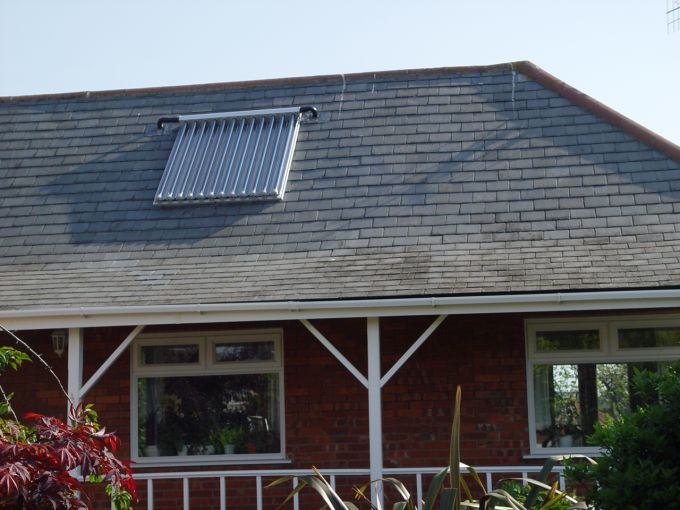
Those of you who have visited my site before will be aware of my page on Solar Thermal Domestic, hot water heating, and the problems we encountered with the Company undertaking the installation
That was in 1997 and despite the problems and the fact that we were basically left to complete the job and make damage good ourselves the equipment/system works well and we are still very impressed with it is performance.
You can therefore understand that when we decided to have Microgeneration system (PV) installed we were very cautious and really did our homework before deciding who would undertake the job, this was even more important because we have a large Welsh slate roof and replacing broken slates is far more difficult that replacing an odd tile.
Our property is almost ideally suited for PV in that we have two roof sections that face south and south east which gives us a large expanse of roof available for installing the panels required.
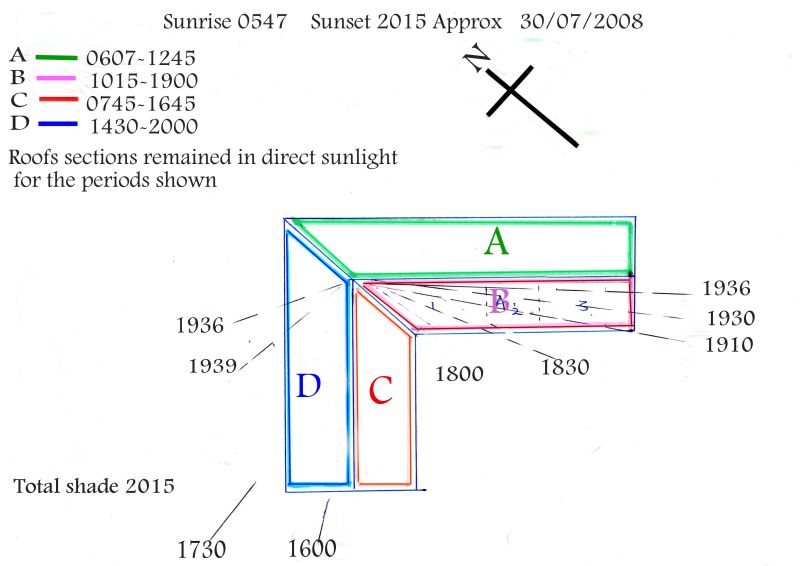
I also did my bit by ensuring that I knew where the best position was for the panels, I did this by monitoring the position of the direct sunlight on the 4 roof sections through out what was possibly one of the best days of the year with sunshine and clear skies all day long, in fact I think I can confidently say we have not had a day like it since!
However I need not have bothered because when I contacted the installers in the first instance they asked for the post code and house number and simply checked the precise direction of the property on the 'Google World' maps which gave them the precise location and directing of the roof area's most appropriate for the solar panels. It was never the less an interesting project from my point of view as I had convinced myself that the property faced South, when it fact it faces South East
Planning Permission?
Owing to the Government relaxing the planning regulations in April 2008 Planning permission on this project was not required . However details of the installation were sent to the local council as a matter of courtesy
Three main criteria needed to be applied, as with the Solar Thermal Hot Water System for which planning consent was required, (September 2007) :-
1. The panels must not project above the ridge of the roof structure
2. The panels must not be more than 200mm above the roof surface.
3. The structure must be removed when/if no longer in use.
The Company of installers were aware of these rules and 1 & 2 were applied.
Lofty
After looking at a number of companies one of which was EDF Energy we finally settled on a company based in the south west of the UK. a company not far along the South Coast, Bournemouth to be precise, this was because they were on the list of the 'Low Carbon Buildings Organisation's' certified installers, and as a result we would be able to apply for the grant which was at that time available from the Energy Saving Trust towards the cost of the installation.
However this was only possible providing they as certified/listed installers installed equipment certified/approved by that organisation.
In our case 'Kyocera'( KC130GHT-2 ) Photovoltaic panels were fitted, so it is important to check this out before signing any documentation or contract.
In our case and at time the organisation was the EST. Energy Saving trust, low carbon building project.
However this certification task now appears to have been taken over by the Microgeneration Certificate Scheme, who have a list of approved installers.
Find MCS installers
Do remember if getting quotes from more than one company which is always best practise to use precisely the same specification/details for the quote , for instance make of panel, number of panels, size of system KWh. also ensure that what is included with one company is included with another, it has for instance come to light that some companies charge extra for the scaffolding which can increase the total price quite considerably.
Rouge Traders.
Beware Beware there are cowboys out there!
Use the MCS Register link above to check. Please don't rely on brochures and paper work supplied by the company, that's how we got caught on out on the Solar Thermal installation.
A MCS registered member will only install certified panels so you will be assured that you newly installed system meets the new requirements and you will be able to register for the FITS Feed In Tariffs) with OFGEM.
A certificate of compliance and completion will be issued when you system is commissioned this certificate is required to enable you to register your generator for FITs with OFGEM, your installer will advise you of the procedure.
However you would be well advised to ensure you have an Energy Company (A company supplying electrical power to properties) lined up that will accept your generator (PV System) early in the process, as the Company name must be entered onto the OFGEM forms when you register for FITs payments, which are made by the Energy Company accepting you generator onto their register.
21/2/2011 Some companies such as 'Scottish Power' are already declining taking on new generators unless you already have an electricity account for imported energy with them. So do check.
If however your electricity account is not with one of the big six energy companies then they may take you on, it is worth enquiring. Telephone 0141 5682000.
The big six companies are:- Scottish Power
SEE) Scottish & Southern Electric EDF N Power E' On
Having agreed on our system which has a 2.08Kwh theoretical output and the roof on which it should be installed with the sales person, The company then carried out a survey to determine the suitability of the property and to see where the various items of equipment could be fitted and inspection of the electrical system fuse box etc was also undertaken .This was undertaken by a the company surveyor. This was undertaken by the company we used free of charge. It is worth noting that a number of the companies initially contacted wanted an up front payment of £250 to carry out the survey and the fee was only refundable if you entered into a contract with them, so if your property for some reason was found to be unsuitable or you changed you mind for any reason, you would be out of pocket by £250.00 straight away. So check this before you commit.
It is worth noting that a number of the companies initially contacted wanted an up front payment of £250 to carry out the survey and the fee was only refundable if you entered into a contract with them, so if your property for some reason was found to be unsuitable or you changed you mind for any reason, you would be out of pocket by £250.00 straight away. So check this before you commit.
Our property was inspected/surveyed and found to be suitable although it was made clear that we would want a new 'consumer unit' to meet the latest standards our existing unit was 25 years old and although very serviceable was not deemed suitable when forming part of the new Photovoltaic system as it was not fitted with RCD breakers.
(Modern installations incorporate a Residual Current Device (RCD) before the consumer unit which trips the whole system off if a fault is detected, In fact it is so sensitive that it trips out even when a bulb blows, which is wholly inconvenient but at least it provided maximum protection against electrical shocks which of course can KILL.
The installers would provide and fit the new unit as part of the overall installation, albeit did add to the total cost of our system.
The installation was scheduled to take two days and commenced on the 8th of September 2008, 4 weeks after placing the order.
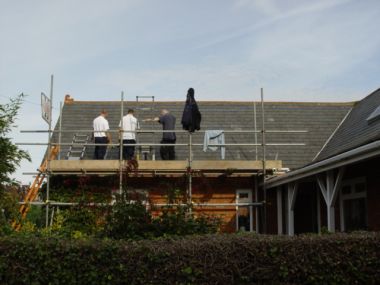
Scaffolding arranged by the Company was erected by outside contractors and the companies team of Installers turned up as promised, promptly on the morning of the 8th September. 2008
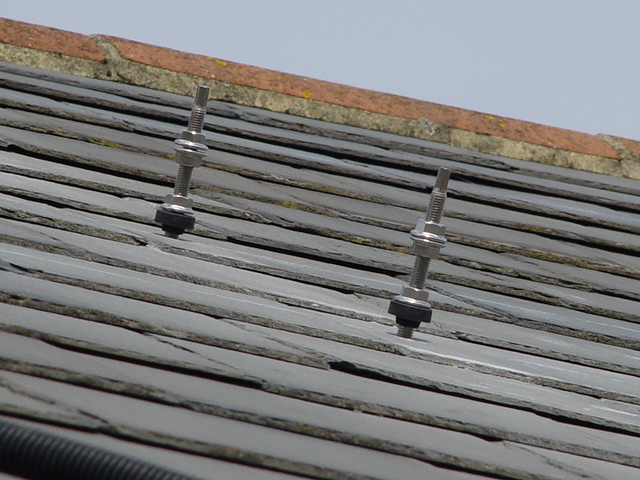
The team of 3 men got to work and marked out the roof for the installation, and fixing of the support brackets and rails onto which the photovoltaic panels would be mounted.
The fixing bolts were sealed against the slate by rubber gaskets sealing rings and sealant to ensure water tightness, No slates were replaced or damaged during the fitting.
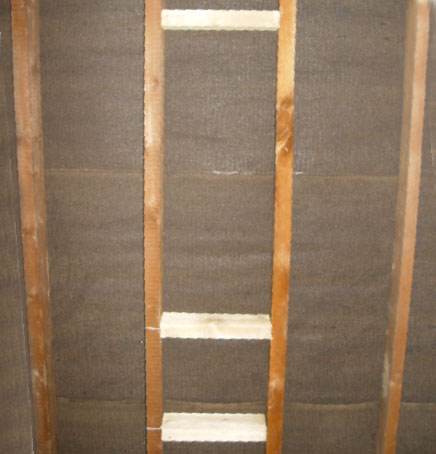
Noggins were positioned between the rafters, effectively giving more strength to the fixing, and rafters bearing the load these were secured using a nail gun, simpler than the brackets I used on the hot water system, a case of modern tools being available and put to good use.
More importantly the roofing felt located beneath the slate was not broken other than where the fixing bolts were fitted to the rafters. the integrity of the roof was maintained by the fitting of the rubber sealing rings (gaskets) fitted on the fixing bolts on the roof surface.
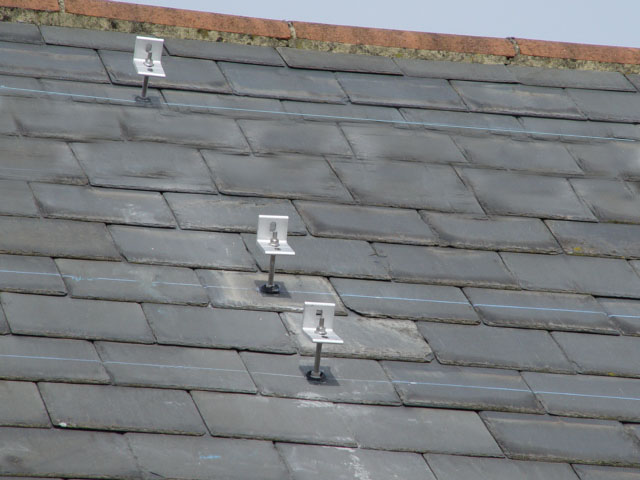
Right angle fixing plates were then positioned onto the fixings bolts ready for the rails on which the solar panels would be mounted.
However the system for fixing the rails onto tile clad roofs is different and easier as the tiles can be lifted the brackets fixed and the tiles simply replaced making a very neat job, the rails the panels are mounted on is then attached to the and supported by the preformed leg built into the bracket.
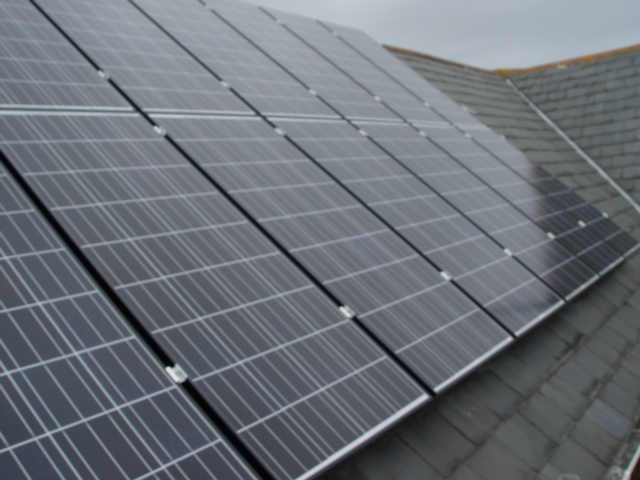
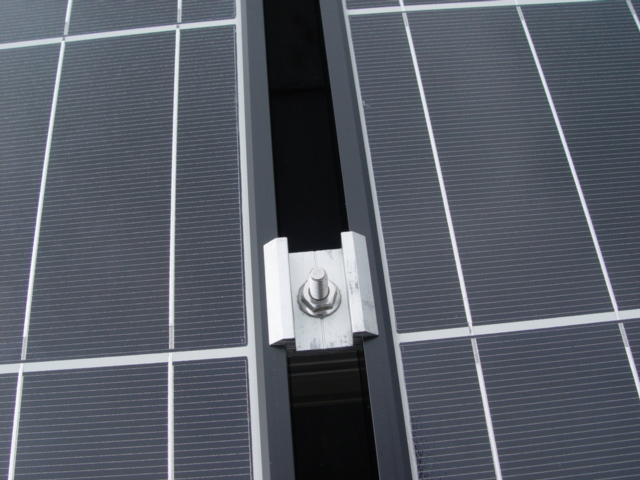
The 16 panels were quickly attached to the 'Unirac' aluminium framework. The panels are large, being approx 143cm x 65cm (56" x 25.5") the upper surface is toughened glass, however like all glass they needed to be treated with respect. and the surface of the electronics being black matched in with the slate well.
Each of the panels had the electrical wire pre attached ready for assembly.
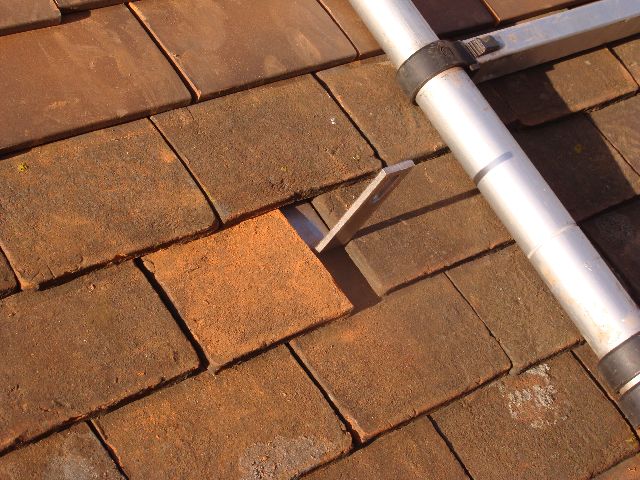
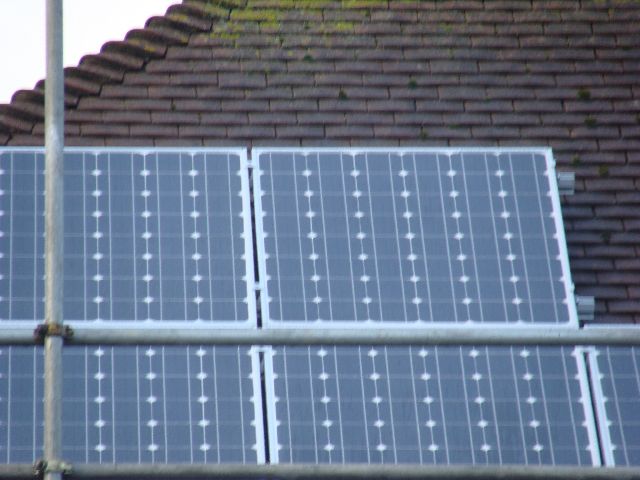 The Sharp panels currently being fitted by the company are very much larger than the panels fitted to my roof and are supported by an aluminium frame.
The fixing brackets are neater than those used on the slate roofs being simply secured to the rafters, the tiles replaced.
The supporting/fixing rail is then secured to the brackets.
along with the panels which are supported by the rails
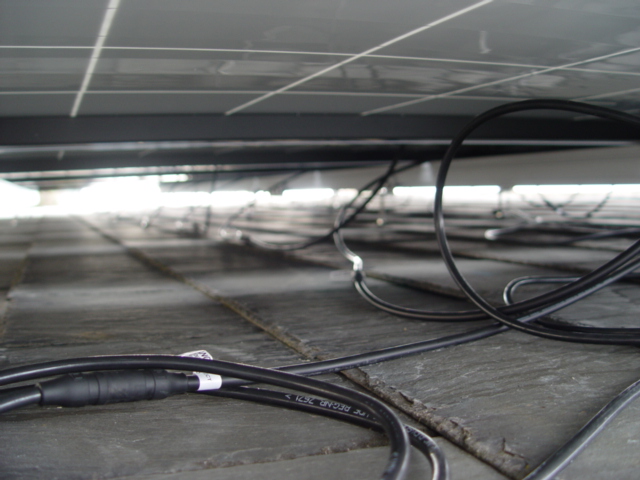
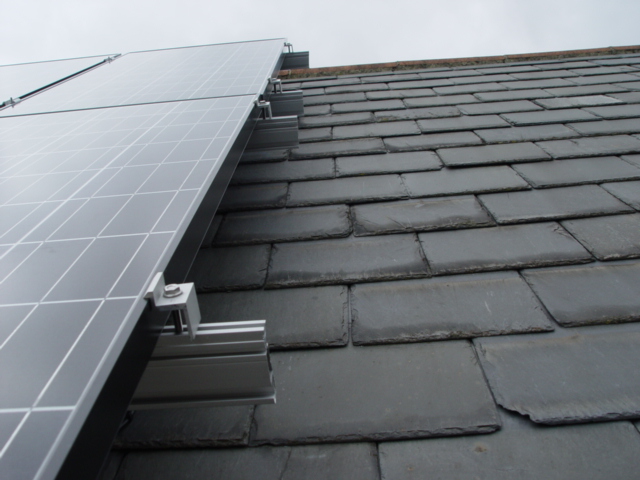
Beneath the panels can be seen the framework on which the panels are securely mounted and the inter-connecting cables, connected in series and taking the combined power from the panels in the form of Direct current (DC) to the inverter which is located in the loft area. space.
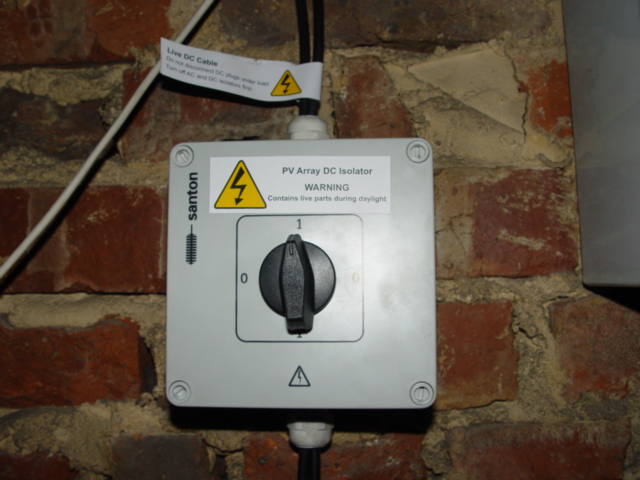
Situated on the solar panel side of the system is a DC isolation switch this is a very necessary part of the system as once installed the panels cannot be shut down unless this vital switch is installed.
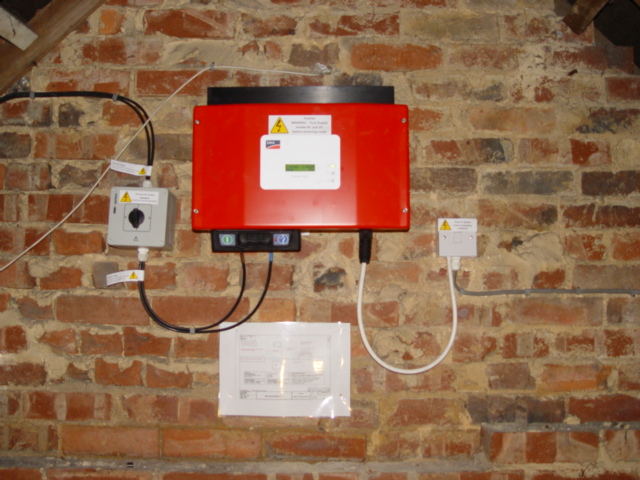
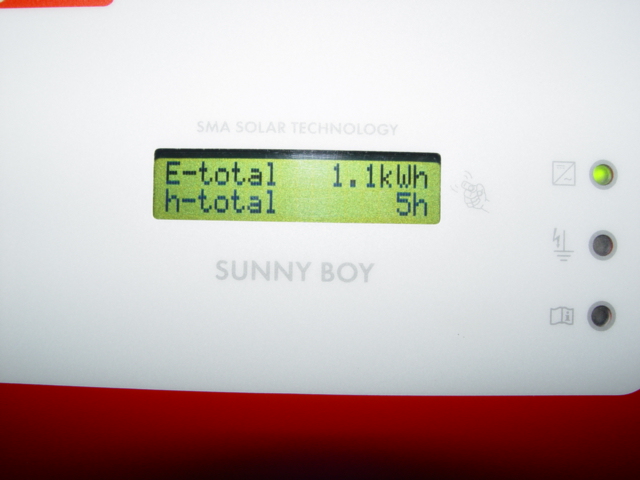
We then have the inverter which converts Direct power(DC) current to Alternating current(AC) which is compatible with the power supply used on the National Grid.
(National distribution network serving all consumers of mains electricity )
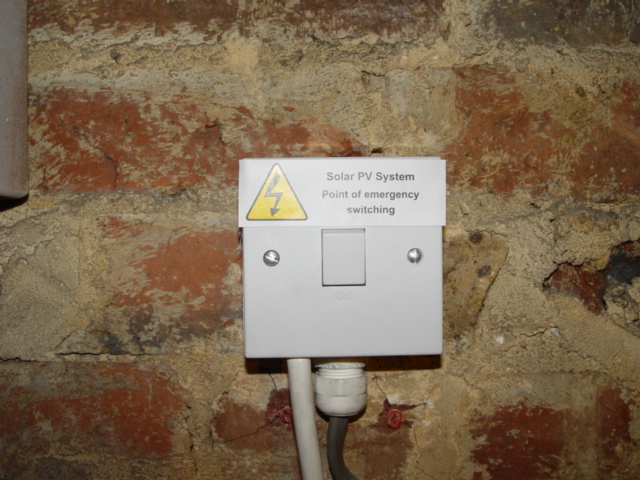 On the AC side of the inverter, again there is an isolating switch, this would allow the inverter to be replaced or worked on by Qualified Electricians and can be used as a secondary means of isolating the panels from the buildings electrical circuits.
The display on the Inverter clearly shows the power generated and the hours run, this as can be seen was taken very soon after the installation was commissioned /completed.
An AC (alternating Current) mains cable runs from the
AC isolator switch in the loft to another isolating switch. located adjacent to the consumer unit
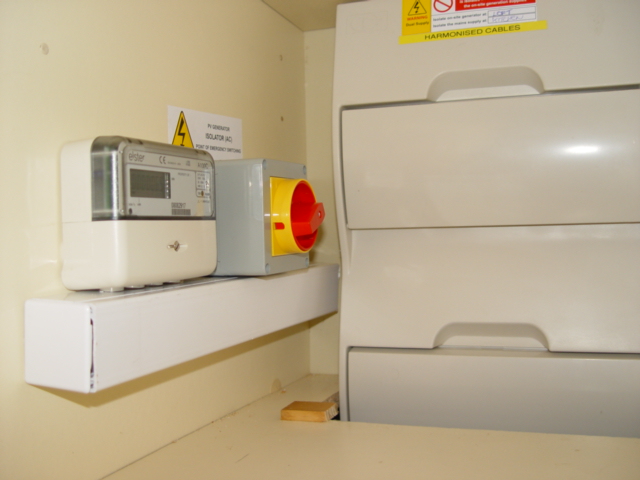
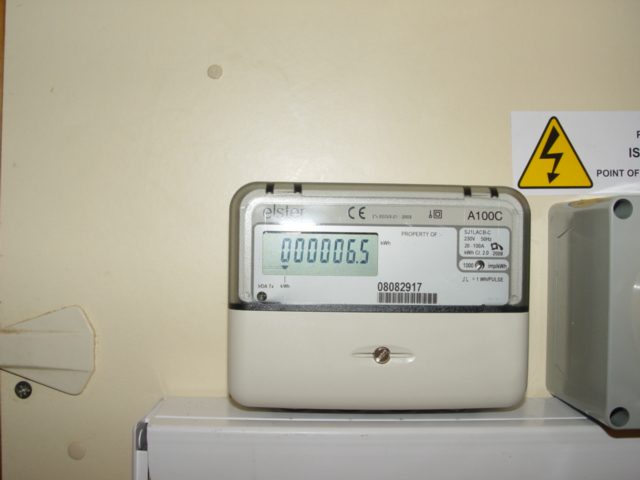 'Householders Distribution Board')which controls/provides power to services within the household This along with a 'Total Generation Meter' are located directly adjacent to the new consumer unit,
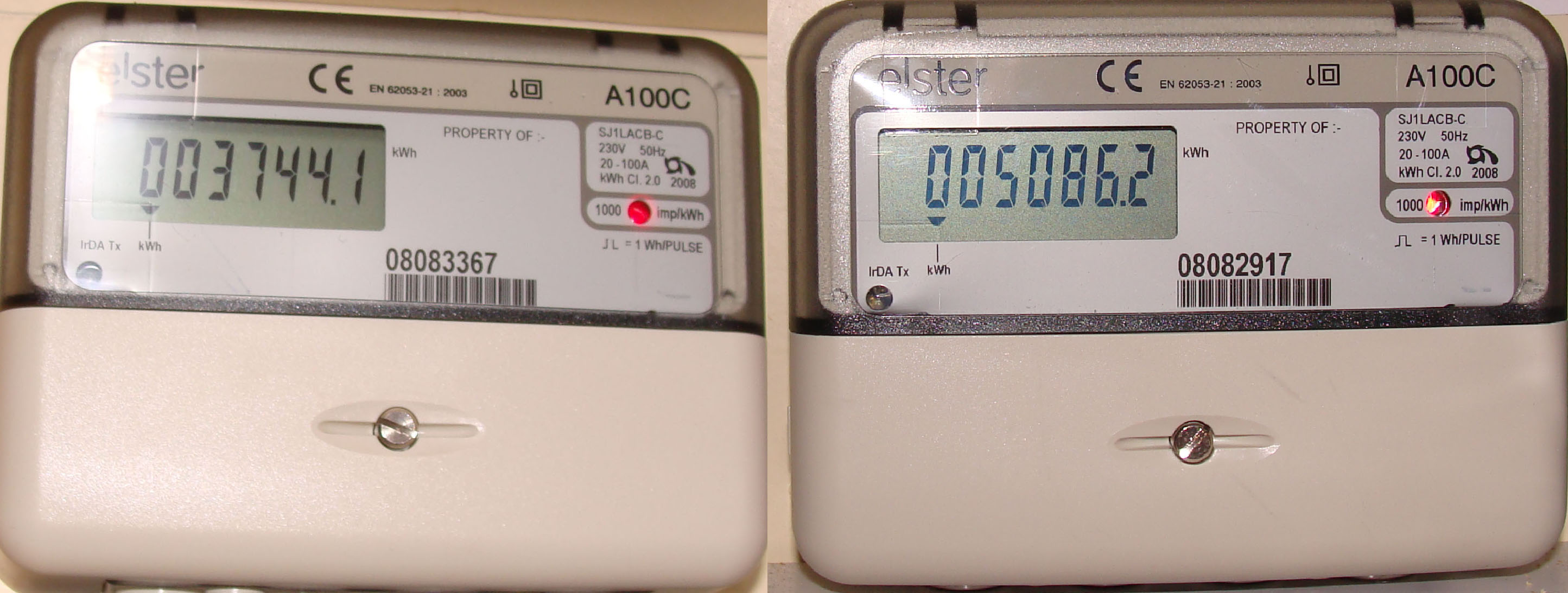
It is of course necessary for your installer to place the TGM meter's where YOU can read it/them, albeit you only need to read this meter four times per year. In my experience this meter is not read by the Energy Company .
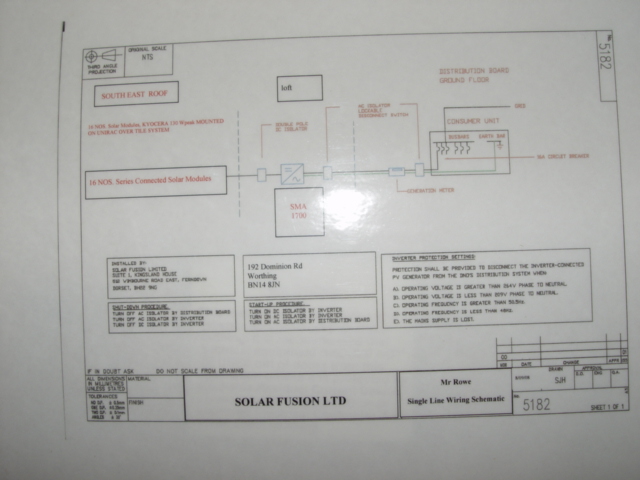
Along with these items is another copy of the single line schematic diagram which clearly shows the location of each and every piece of equipment in the system, as well as address details and system number.
" Two Copies of this document are displayed on the system, One above the consumer unit and one adjacent to the inverter.
This is provided to enable any qualified person working on the system to have complete and all information to hand before undertaking any work necessary on the system and also to comply with the requirements of the 'Health and safety at work act'
The job scheduled to take two to three days was completed in just over one very full day plus a couple of full hours on the next day.
The professionalism of the crew was excellent with no complaints, and I'm not the easiest person to please. As you can see from the photographs I monitored the installation very closely and had absolutely no complaints.
I was given a complete explanation and tour of the system by the senior fitter and every thing was made clear as to what each component was for and why it was fitted.
The paperwork, manuals etc and final receipt along with the certificate of completion and compliance have been received and they along with other documents to the Energy Saving Trust Low Carbon Buildings programme ) for payment of the grant of £2500.00 which was off set against the overall cost.
EST Grants are no longer available However the Generous payments paid under FITs to installers since the 01.04.10 will greatly out weigh the grant received from the EST.
So is the PV System Working Enquire/purchase Eco-Eye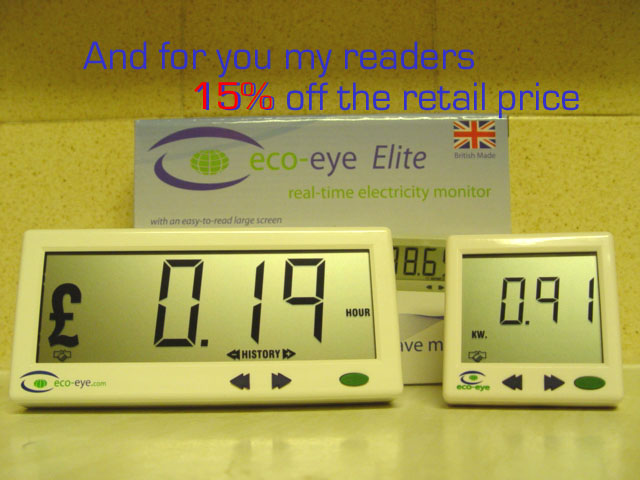
Yes and very effective it is, and if you want to monitor the import and export of electricity to your premise, be it your home or office, or see precisely what a particular appliance is using in watts/kilowatts then the 'eco-eye' is the tool you need.
Since obtaining the two shown on this page they have saved me £££s. I will give you just one example:-
I have a compressor from which I charge the car's tyres and use an air line. The motor on the compressor is pressure controlled so it only runs until the pressure is built up to the pre determined pressure and then cuts out, re-starting automatically as the pressure drops due to either use or due to slight leak on the hose connection.
I used the compressor to correct the pressure prior to taking my car for MOT and thought I turned the compressor off.
However reading the 'Eco-Eye' meter's late that evening they indicated to me that we were using more power than was normal, having searched the house for the offending appliance I found nothing, however when I went to the garage the compressor I had used and left switched on had just re-started, being controlled by a pressure switch, that's what was increasing our demand above the norm and the 'Eco-Eye had made me aware of it. I had neglected to turn of at the power switch.
Had I not been alerted to the increased demand by the 'Eco-Eye' it could easily have been left intermittingly running on and off for the next 24 hours or so.
It is also interesting to note that although the designers did not have exported energy in mind, these meters actually show you what amount of energy is being exported from your PV system (returned to the National grid) A very useful tool and well worth the money.
One things for sure at today's prices for electricity you don't need to have many incidents like that for this useful meter to pay for itself.
And talking about paying if you would like an 'Eco-Eye for you property, be it Home or Office then
I have arranged for you to receive a 15% discount off the retail price when you order
All you need to do is go to this link:-
www.Eco-Eye.com select the 'Eco-Eye' you require and when you reach the check out enter:- aclassinfo in the promotional code box provided, (all small case) then click, Apply that will automatically reduce the cost of the item by 15%.
You like me will then be able to immediately monitor the demand to you property, as well as measure the demand and cost of running individual appliances, simply by turning them On or Off.
In the photo I have used both of the meters types available, the 'Elite' & the 'Mini' one having a much larger display and wall mounting facility, both meters can be totally portable being battery powered and can be sited where it catches your eye. The 'Eco-Eye' can be set to give you various readings, in this instance the combined meters show that we are currently importing (demanding)from the national grid which is 0.91 of a KWh. Just under 1KW per hour and the second meter having be set to calculate cost which shows that it is costing 19pence per hour, the cost per unit (One-kilowatt) being set at 20.23 pence per hour. These settings and costs are set by the user when setting up the meter, full operating procedures and set up instructions come with your well packed meter
Oh and remember you don't need to invest in solar energy to find the 'Eco-Eye useful, savings start from the day you purchase just by being thrifty with what's switched on and when!)
I would like to thank the Management of 'Eco-Eye.com' for granting this concession to my readers, it is appreciated.
Energy Companies licensed with OFGEM to administer FITs
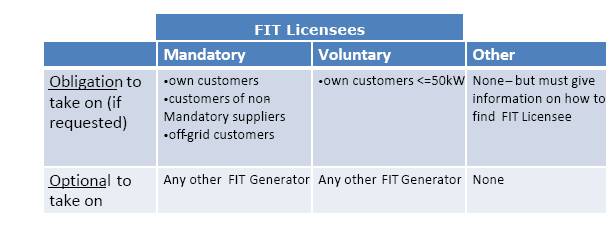 Some of the companies on this list will require you to take your imported energy from them. It is therefore normal practice to register you generator with the company that is supplying your imported energy to your property at that time.
This does not tie you to that company for imported energy in the long term if you can get a better deal for imported energy when your current contract ends(If indeed you have one?).
Your Microgeneration account can be moved to your new company or left with the existing company.
In that instance your generated energy would be paid by cheque of bank transfer and distinct from being credited to your imported energy account.
There is no advantage to moving your microgeneration account as all registered companies will be required to make the same payments under the levelisation system in force, FITs regulations.
If however the company that you purchase your energy from is not on the OFGEM list of licensed FITs companies then you can apply to any of the companies on OFGEMs list, who in the circumstances should take you generator onto their list for registration and FITs payments.
The first payment may take several months as the Energy Company has to register your generator with OFGEM before payments can start, your system being allocated given a FIT registration Number
Your Microgenetion contract or Statement of Terms and conditions may differ from company to company as does the date at which meter readings are submitted to them,
In the case of Scottish & Southern Electric as well as out new provider Microtricty, the year starts on the 1st April, N-power have a totally different system as do E-On so do check your conditions or contact your company to get the information as in the case of three of these companies the details are not available in the documentation you receive when opening the account.
Most companies state they will contact you when readings are required and give the time period in which you must provide them to be paid for that quarter/period, however do not rely on this as N-Power for instance did not notify one owner who has now to wait until the next quarter for payment not having been advised that readings were requires missed the closing date for the current readings, making it six months plus the delay in payment before any funds are received or credited to an account, supply or bank.
Any adjustments made whether increases or decreases as a result of the retail price index(RPI ) will take effect from the beginning of that period.
How and when will I get paid for the energy I generate
Under the Energy Bill secondary legislation 01/04/2010 feed in tariffs(FITs)you will be paid for the energy /units recorded on your TGM,(Total Generation Meter)which is installed as part of your PV system.
In addition to the KWh (Kilowatt hours) (1 X KWh = 1000 Watts) you will also be paid for 50% of the energy recoded on your TGM which will be deemed to have been exported. This figure is set for all generators at 3.1p per KWh.
This 50% will be paid whether you have used the energy or not.
So to confirm under the FITs scheme you will be paid for all units recorded on your TGM irrespective of whether you use the energy in your own home or not, there will be times when you will be exporting (Sending power to the grid) and times when you will be topping up your demand from the national grid, but at the end of the day your energy costs will be lower because you PV system is subsidising your demand for electricity and your carbon footprint will be a great deal smaller.
Most power supply companies will ask you to forward the reading from your Total Generation Meter (TGM's) installed as part of your PV system quarterly (4 times ) a year starting on the 1st of April each year and then pay you accordingly.
You should bear in mind that without the readings being submitted within the time period set out in you contact or contained in the e-mail requesting the readings you will not get paid until the following quarter for the earlier quarter.
This is because the energy companies themselves have to submit the total cost of their customers readings to OFGEM who then arrange payment through the levelisation scheme
(I.e if a company on the OFGEM list of approved companies registered with OFGEM for FITs provision has a 10% share of the energy market then they would contribute 10% of the total FITs energy bill, into the scheme via OFGEM,
Companies with a larger share, one of the big six companies for instance would obviously pay more into the FITs pot) This accounts to some degree for the delays in payments to customers.
In some instances the payment will be sent to you but if your energy supplier is the same company that you are selling your energy to, then you may be given an option and the money earned from PV can be credited to you imported energy bill.
(Energy demanded from the National Grid) where this is not the case then you would obviously receive a cheque or bank credit as arranged with your energy buyer.
Be warned,
One energy company, 'Scottish and Southern Electric' is at present quoting times which in my view are totally unacceptable, Quote
We will endeavour to make payment within the following 13 weeks of receiving your meter readings. Unquote
which effectively means your credit will not be available for you next quarterly bill.
Also in my experience, no confirmation is received by either e-mail or letter as to:-
1. The readings for a given quarter have been received by the company
This in itself can cause further problems as the contract says that where the readings are not received by the company the payment may be carried over the the next quarter making the payment 6 months in arrears
but if they do not acknowledge your readings when you e-mail them, you will not know if they have received them or not! as a result you will not know if you are going to get paid for that quarter
My efforts to get these matters sorted have so far been met with hours on the phone but no positive answers.
with the result that I have now switched my FITs provider albeit I did receive apologies from for the poor service from the company in question, SSE.
so you would be prudent to ask a few question before requesting a company to place your scheme on their register l
'Scottish Power' N Power, on the other hand only pay for generated energy by cheque of Bank transfer and payments when I called Scottish Power 1/3/2011 I was within 14 days of submitting your TGM readings.
Readings submitted on the 1st April 2011, I'm reliably told microgeneration Customers will receive payment by the 15th April 2011.
If you know different please mail me.
N Power when I spoke to them on the 11.4.11 say they have 60 days in which to make payment, however only pay by cheque and will normally do so with a couple of weeks.
Eco-Tricity have indicated a period of 2-3 weeks and pay by bank credit .
Even with bank interest rates low as they are, your generated energy income if banked will earn money, every 3p earned is equivalent to One KWh of exported energy, so look for a company that pays as soon after submitting your readings as possible. Or chase them for payment in the same way they would chase you if you owed them money!
Also due to the fact that these departments are now very busy e-mails only receive an automated response if your lucky, often without follow up.
Watch you hard earned energy income
On another point where as when you set up an energy account with a company the phone call is free, when contacting the microgeneration departments the 0845 system is invariably used
If you are on a
telephone call plan (contract) which excludes the 0845,0870 numbers such as Virgin Media then your call will be charged at premium rate and a phone call will rapidly eat into your microgeneration income while you quite often listen to music and wait many minutes for an answer.
remember if you are on a call plan that does not include 0845 a minute call will cost you 7 hours of exported energy @ 3p per KWh)
My advise is to use the 0800 system that most Energy Companies have and ask to be transferred to the department you require or a Regional number which would come within your telephone call plan and cost you no extra on your telephone bill.
Virgin Media will now include 0845 0870 numbers for an extra £2.00 however the equates to 66.KW hours of exported energy per month which is more than most systems will export.
a lot of numbers can be located by using this site: Say No to 0870 & 0845 numbers, Also if you find or have useful not premium rate numbers you can add them to their index.
Some companies have in the past required Import/Export meters however the cost of installing this extra feature to the system will be at your cost, albeit at this time Southern Electric are still installing the meters FOC 5/4/10
The payment you receive will be wholly based on the Export meter readings and your 'Total Generation Meter'
Bear in mind you will still get an electricity bill for the units you have Imported (used from the national grid )
Solar energy both PV and domestic hot water do not work at night.
Remember the price increases for Imported power are very much in fashion at present,(Aug.Sept.2008) and you need to watch the suppliers of electricity very closely to get the best deal.
On line accounts tariffs no paper billing, are considerably better, so shop around.
Another point that is worth bearing in mind is that although you will almost certainly have registered your Microgeneration system with your present supplier, you are not now tied to that company for energy for life, if you can find a competitive company then you can change suppliers subject to contract, this can take up to six weeks so be prepared to wait that long before you see the changes.
you can however start the process 28 days in advance of a contract terminating as it takes a minimum of 28 days to switch plus the cooling off period.
By contacting the individual companies and arranging the deal yourself it is usually more lucrative than using a online energy compare sites, so only use them as a guide but do the deal yourself and get a better rate. In some cases the companies best deals do not even show on compare sites.>
There would however be no advantage in switching your microgeneration account as the FITs payments are fixed and all companies are required to pay the same rates under the FITs regulations.
However if you are not satisfied with the service you are getting from the company you selected for FITs provision, like your import account you can switch. This also takes approx 28 days and you must comply with the content and details in your existing FITs contract.
Remember you may need to wait to do this until your existing import account contract runs out as most companies now are requiring you to switch you import account to them if you are wanting to switch you FITs provider. So may sure you do not 'jump out of the frying pan and into the fire' dissatisfaction may be more acceptable than higher import energy costs! Remember once set up you should have no need to contact your FITs provider if they are doing their job well.
Factors which affect the price you receive for the energy generated:-
1. Date of installation. Pre 15/7/09 or Post 15/07/09
2. Year of installation (Post FITs)
3. Whether fitted to New or existing property (Retrofit)
4. Size of system fitted, Post(15/7/09)FITs, Do not exceed a 4.0KWh system for best return on your investment.
 Note
Note
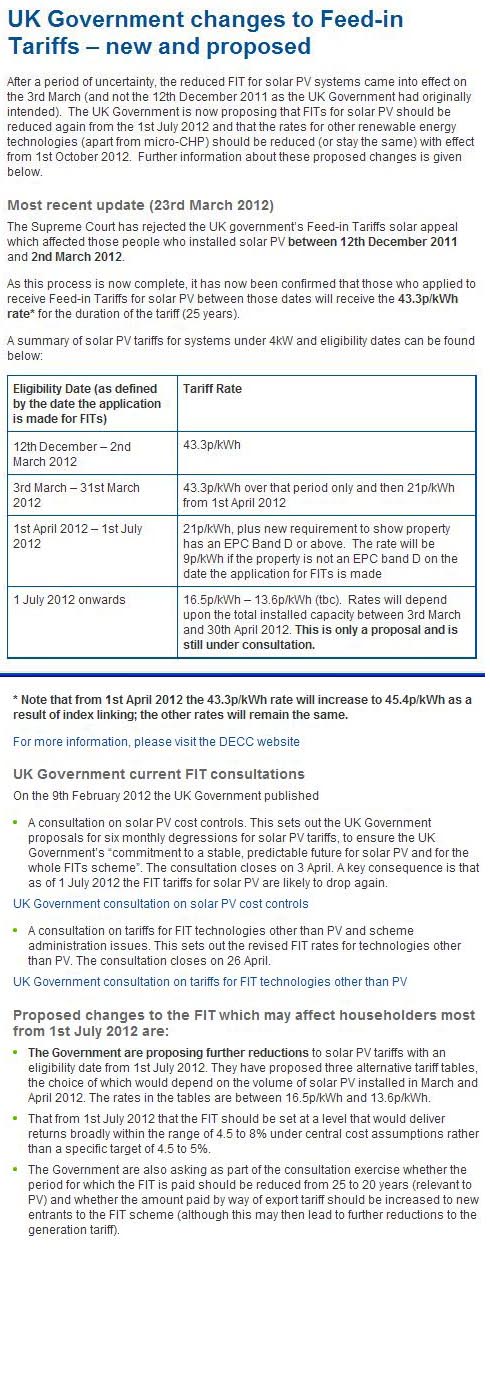
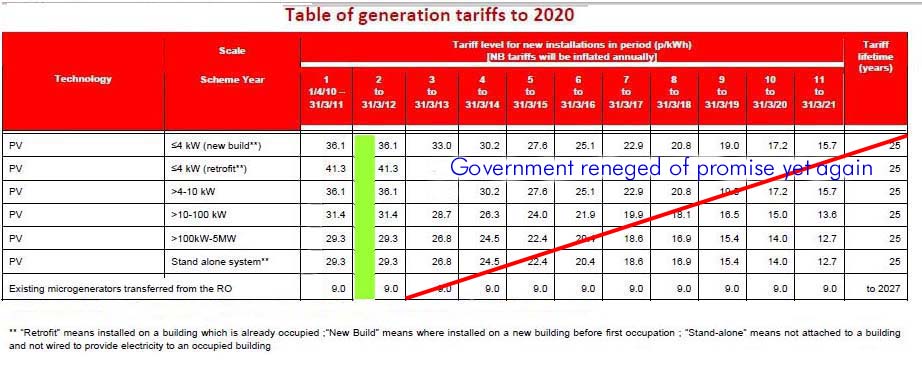
In addition to the above payments of 3p Per KWh will be paid for 50% of the units recorded on your TGM
i.e 0-4KWh Retrofit:- 1000 KWh recorded on the TGM at the end of a given period will have a value of:- 1000 x 43.1p = £431.00 plus 50% of TGM reading = 500 units @ 3.1p = £15.50, total value £446.50 + The value of the KWh ' Used In House' See below.
And in addition to the above you have the value of the KWh of energy 'used in House', You can calculate the value of this by looking at your Electricity bill.
The Energy Company who you are contracted to for FITs payments will be paying you for 100% of the units recorded on your Total Generation Meter (TGM) in addition you will be paid for 50% of that figure , deemed to have been exported by the energy act AND you have the value of the 50% used in house Minimum although there is every chance you will use a great deal more than the 50% in House, The ideal situation of course would be to use it all and that's where the Eco-Eye comes in, that will enable you to monitor the exported (out going) and Imported (incoming power) over a given period and enable you to manage your Installation to the full by using appliances when you have maximum incoming power from your system.
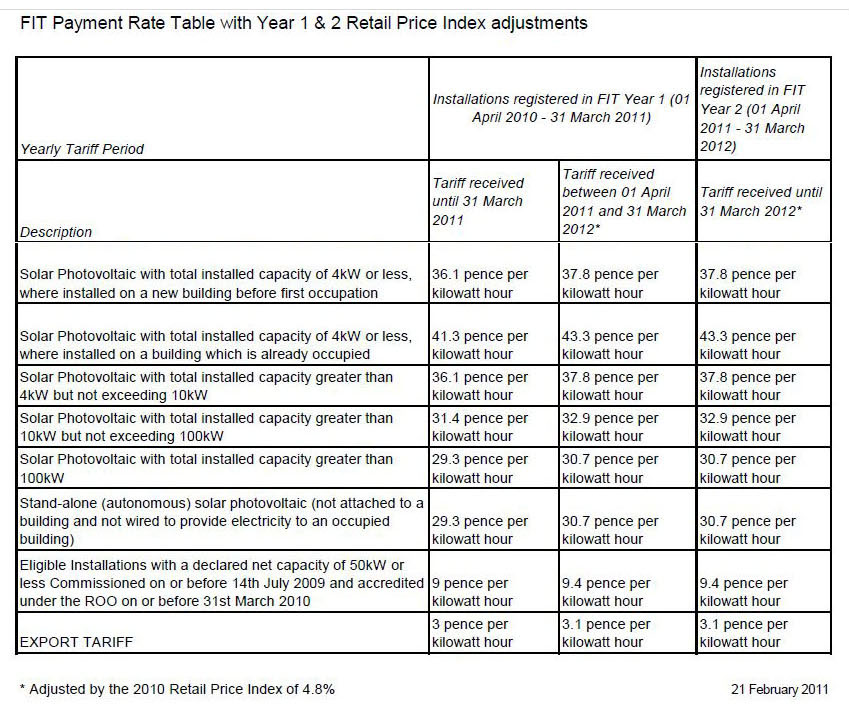
The above tariffs apply from April 1st 2011 the partial document being downloaded from the
OFGEM web site.
The standard question is:- But what if I'm out all Day and thus not using energy?
Well for that to be the case your property would be a most unusual.
The majority if not all of us have appliances such as refrigerators, freezers, time-switches, Telephone systems/answer machines, alarms, house and in some cases fire alarms which are connected to the national grid via our consumer units and meters, pumps for central heating, Even gas boilers require electricity to function, all of which consumes power as of course do appliances on stand-by, TV's etc
Your 'in house' use includes all these items and more.
Going on the Daily Records I've maintained of our installations I calculate that a generator of 2KWh will in practice generate approx 1.7 1.8KWh if ideally situated and I estimate you will use at least 35-45% of that figure to maintain power the appliances mentioned that's without such things as dish-washers, washing machines Audio/Visual equipment etc etc, when you are at home.
The list is endless but all can be subsidised/powered using power from your PV system.
We as a couple are very energy conscious and our demand is approx 0.56KW per hour, just over half a KWh per hour so it is easy to see how over the period of a year money can be saved on your Imported energy Bill. Plus of course the VAT.
However remember this is not cheap energy being supplied as the Government would have you believe, it is energy supplied by your generator, the value of which realistically has to be deducted from your capital investment. However it worth being in mind that just as Imported energy costs rise so the value of a KWh of energy 'used in house' will rise.
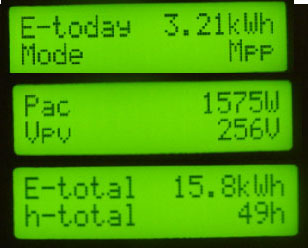
On the morning of the 13th September a real summers day, for a couple of hours at least with Sunshine! These reading were taken from the PV Inverter readout.
As can be seen the PV has generated 3.21KWh today and at the time the photograph was taken was producing 1575watts(1.575KWh) of electrical power, enough to light 157 100watt light bulbs, that is a considerable amount of power and should under no circumstances be underestimated from the hazard point of view.
The reading stresses the need for householders and electricians alike to be aware that even with the mains power switched off OR POWER CUT (localised failure of the national Grid system) all of the circuits in the household and out building provided with electrical power will be very much alive during the day light hours
Only by switching off the PV system and Mains Power will the electrical circuitry be totally safe.
And as can be seen 15.8KWh of power has been generated since the system was commissioned.
The displays in this photograph appear one after the other on the inverter and are not normally seen together.
Another very interesting feature and one that householders should be aware of, is that the system shuts down after dark, so if you in your loft or area where the inverter is located and see that the inverter display is off don't worry It will reappear as soon as daylight returns.
However the 'Total Generation Meter' sited in close proximity to your consumer unit will be displaying total power generated in KW (kilowatts)since installation.
e-mail Lofty
How can I get maximum support from my PV installation.
Prior to the 1/4/10 I was advocating using your electrical appliances such as dish washers and washing machines so as to get maximum benefit from the cheap energy (Low tariff) on E7, you will want to get maximum support and thus financial gain from your PV.
However the situation in my view has now changed.
To get maximum support from your PV now, you need to use your appliances, such as dish washers ,washing machines , electrical tools, gardening tools such as shredders electrical mowers etc, on clear days preferably when the sun is shining, then your demand from the national grid will be subsidised if not completely supplied by your PV system, remember the higher your 'used in house reading' the greater the saving as you will not only have used the energy generated but will also be paid for it, as it is still recorded on your TGM.
It might not always be convenient to wait until the sun shines but the befits of doing so will be seen when it comes to calculating & paying your electricity bill as well as in the case of post PV installers calculating your income from the PV.
Pre 15/7/09 installers, I fear like us you will not now see much of a return on your investment.
For details of my own generation /consumption figures go to PV.8
I received a technical information folder from The installers which includes literally everything you or your electrical contractors, network providers etc need to know about the installation. This includes procedures for isolating the PV, as well as start up procedures. I feel the householder should be at at least familiar/aware of these two procedures.
Individual households will have their own folder however the isolation and start procedure should remain the same.
Procedures
System Isolation Procedure.
Turn Off the AC isolator located near your consumer unit marked 1
Switch off the AC Isolator situated near the inverter 2
Switch off the DC isolator situated near the Inverter 3
Your layout may differ from that shown.
System Start up Procedure.
Switch On DC Isolator 3
Switch on AC isolator 2
Turn on AC Isolator near consumer unit. 1
The majority of the content in the folder would be best understood by the professionals.
This document obviously needs to be kept safe, as it will need to be passed on to the new owner of the property with the deeds of the property when the property is sold, along with all other relevant documentation.
Well I think the first thing to mention is that we did not venture into the Solar World for the purpose of making money! Saving money is a totally different venture, Which is just as well bearing in mind the disgusting way in which the Government of the day have treated installers of PV prior to the amendments to the energy bill 1/4/10.and the way the coalition have reneged on their promise the level the playing field for FITs payments.
We as a couple will have reduced our carbon foot print by installing the solar domestic water heating system and the photovoltaic and that truly was the aim, if it will help make the World a better place for our grand children and their children then that's all we can ask.
Having said that, we still want to get the best deal from our investment although we fully appreciate we will never get the capital invested back.
So to assist us in making this decision we have to do some calculations, bearing in mind that solar works best on bright sunny days although it does work with overcast bright days as well.
Where you live in the country is going to have an effect on your solar systems performance and fortunately we live in the area of the country that gets most sunshine. The Sunny South coast of the UK.
Don't take my word for it take a look at this site, The sunny South Coast (The maximum recorded duration of sunshine in a single month is 383.9 hours at Eastbourne just along the coast from us in July 1911).But of course to get that from your solar PV it would have to have a device which tracked the sun all day, fixed roof system start low early morning peak and then slowly decrease as the earth moves in relation to the position of the sun.
I worked out that we get an average of 5 hours a day sunshine over the entire year, however going by the records kept I've been just a little extravagant with my figures, it appears it is nearer 4.5 - 4.75 hours , and our photovoltaic now has theoretical max output of 4.16KWh however that's if every thing such as position of panels etc was 100% ideal all the time, so I'm working on a figure of 2.75KWh. This is a conservative figure, things can then only improve!
How much of this are we going to use per hour? ,Well our Eco-eye electricity consumption meter has been indicating a consumption of about 0.50KWh (500watts) over several months, this obviously changes when kettles, cookers etc are switched on, equally there are times when the demand is less so I estimate this will leave a balance of approx 2KWh to export to the grid each hour averaged over the period of a year.
More accurate figures can now be viewed on my records kept and updated daily Daily records Remember the most important thing is you will be helping the environment by using Solar Power to generate electricity and or heat your Domestic Hot Water. Please bear in mind and as mentioned above these figures are based on a photovoltaic system with a output of 4.16KWh.
You may find also find the information these sites useful & Interesting
1.The list of Ofgem approved gross generation meters Ofgem website at:-
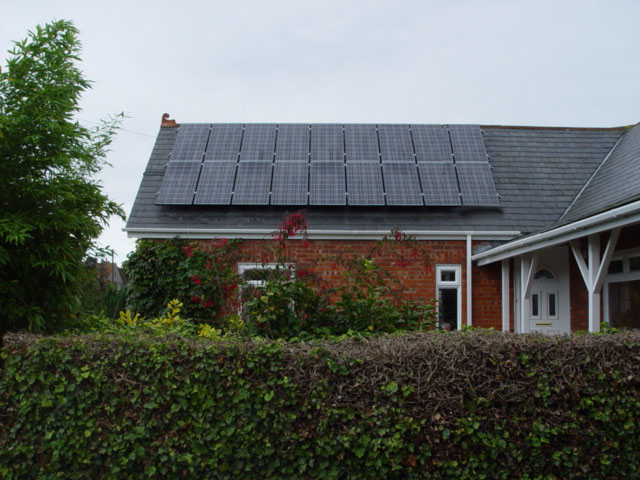
12th of September 2008 Scaffold gone. Job complete.
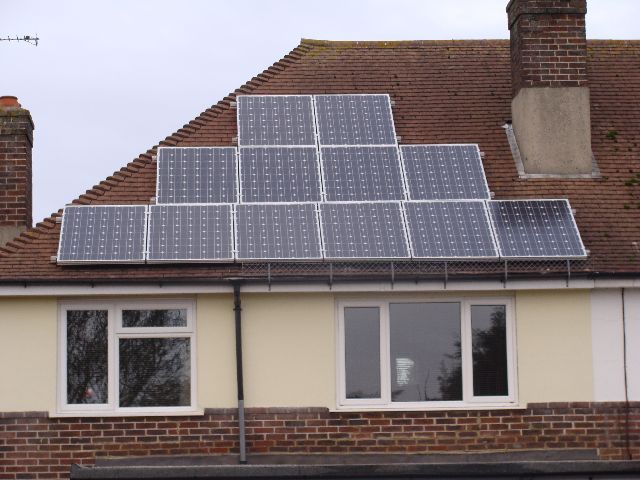
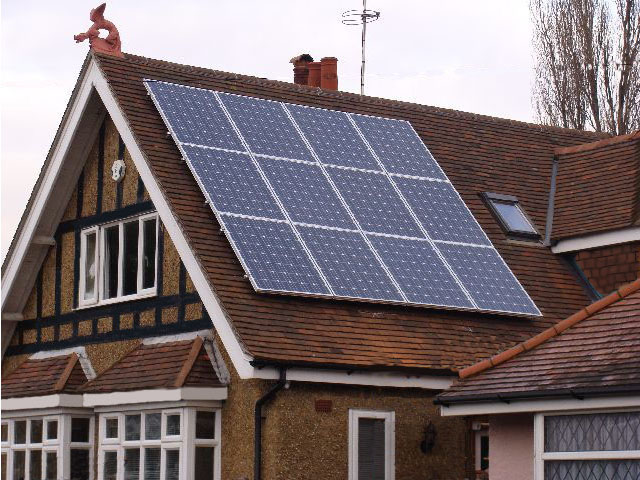
These 12 panel 2KWh systems were also installed by the same company and completed during January 2011
Both systems having been installed by a MCS approved installer are eligible for full FITs payments for 25 years @ 43.3pence per KWh for the Total generation and 50% of the TGM reading at the end any given period will be deemed under the energy bill to have been exported and eligible for a further payment of 3.1 pence per KWh.(As of the 1st April 2011)
However remember to get that best price for the energy your generator produces you must have completed your installation and registered with an Energy company/OFGEM for FITs before 31st March 2012 when the prices paid to new installers may also be reviewed
Installation completed after that date will receive a lower price per KWh. See above chart.
Using generation figures obtained from a 2KWh system, facing due South the expected return is £1200 per annum in hard cash or credit off your energy bill, that figure does not include the value of the Energy saved by using you own generated KWh 's of Energy 'used in house' this cannot be calculated as every house will use a different amount, dependent on the number of electrical lights/appliances when and how used. The FITs regulations deem you to have exported 50% of the Total registered on your Total generation Meter (TGM) although in most cases a greater percentage will be used.
e-mail Lofty Would we recommend the company we used for your installation? Most decidedly, every thing about the Company was spot on and we are very impressed with the professionalism shown right from the ordering of the system to the installing, commissioning and the provision of the well presented detailed information folder every thing you need to know as either the householder or the professional agent on site is contained within that one file.
Help was even available for applying for the grant which went without a hitch, It would not be an easy job without the companies support.
Also despite the fact that PV installers did not install our Solar Thermal (Domestic hot water system) They do also fit these systems which will qualify for FITs payments in 2011.
We have now managed to switch our Electricity account across to 'Southern Electric' as of the 5th Oct 2008 and we have a date for the installation of the Import/Export meter for the 16th of Oct.
However by that time I estimate we will have supplied at least 120KWh of energy to the National Grid for which we will not be paid.
So if you placing an order for PV make the decision as to who you are going to associate your system with (sell you energy to) as early as possible and contact that company to ensure they will accept you onto their FITs register , you need this information when completing the OFGEM registration form Do this to either coincide with your order for PV if not before, or you like us will become a charity and supply energy to the National grid for Free and until you have completed registration.
Your installers with the best will in the world may advise you to go down a particular route in respect of energy companies, Make sure that you are satisfied by placing a call to that company Microgeneration dept.
If you have to pay for the call, take that into account some calls can be complex and long and eat into your profits from the generation, even and I have found that in some cases the staff are not even familiar with the systems your talking about. I can speak for Southern Electric who have a dedicated department and the staff are very well informed.
0845, & 0870 numbers can cost and not all telephone call plans include them, in fact they cost more than a call to a regional number, see my page 2 for more details on this subject.
 Domestic Meters
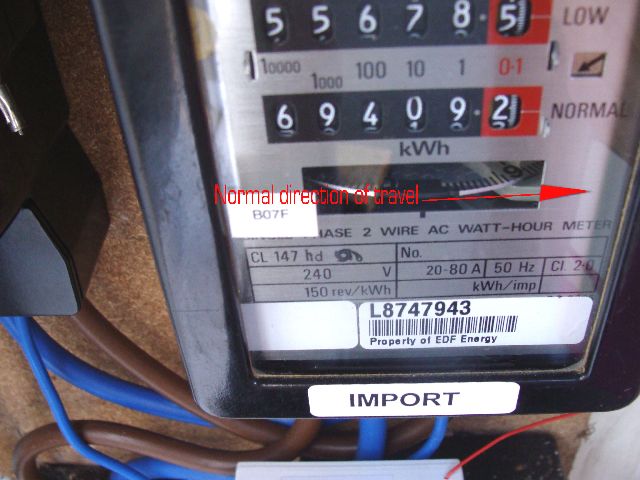
When completing your application form to the Energy Company you have chosen to associate your PV system with, be aware that the form may contain a question asking if your import meter The meter that currently records you KWh of energy used from (the national grid) runs backwards. (clockwise)
This has been known to happen with analogue meters where the PV system is generating more than the household demand and is therefore sending power to the national grid at that point in time.
However you cannot answer this question truthfully unless you watch the meter on a bright sunny day and watch the meter dial, if the dial is seen to turn clockwise then your meter is running backwards. Note it has to revolve 150 times to delete one Kilowatt hour However as soon as the either the demand exceeds the generation or generation is less than demand the meter will turn anti-clockwise.
Once your energy provider is made aware of the situation they may get the network providers Energy company responsible for electricity supply/maintenance in your region to fit a digital meter, there will be no charge for this change.
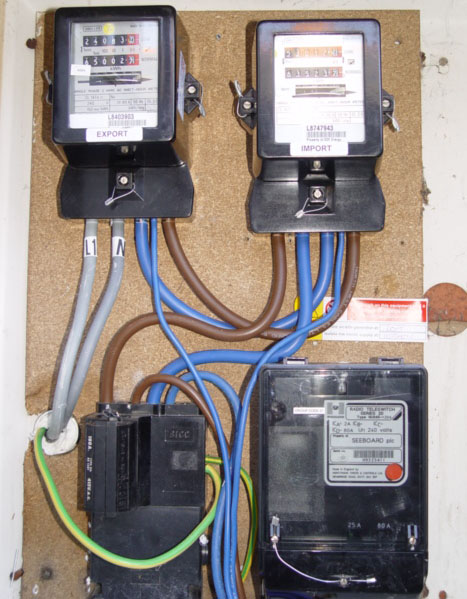
Meters shown in the photograph on the right are of the analogue type. Where an export meter has been fitted as in this case the problem does not arise.
Digital and Smart meters are not affected.
Do I need an export meter
This really depends of the size of your system, in the majority of cases a domestic system consists of 16 panels, number dependent on the make of panel with a combined theoretical output of 2.06 KW per Hour (KWh) which is controlled by the roof surface space available.
If this applies in your case then I would say NO do not have a meter fitted, You will almost certainly use more than 50% of your generated energy in house and so would loose out by fitting the Export meter.
If an export Meter is fitted you will only be paid for the exported energy recorded on that meter be it more or less than 50% of the TGM reading.
If on the other hand you have a larger system like ourselves then YES have a meter fitted because you will export more the 50% and so would loose out financially as the FITs scheme deems you to only have exported 50%, in our case we Export about 70% of the energy we generate. But the decision is yours.
If you do have an export meter fitted you will then finish up with two meters supplied by the network provider for your region, this may not be the same company to whom you intend selling your energy or to whom you pay you bill.
When fitted you will have one meter that records Imported energy ( flowing into your home) and the other Exported energy, (Leaving your home via the national grid) If you are on an E7(Economy seven tariff) you will have 4 readings, Normal and Low on both meters.
On the export meter both Normal and low readings are added together and the total paid at 3p.
On your Import meter you will pay the tariffs indicated in you current contract, so shop around for a good deal, but remember you have have a contact with your existing company so check before you switch or you will have to pay a penalty charge/fee. Bear in mind that it takes 28 days minimum to change supplier so start looking prior to the contract expiry date.
Having had the first installation fitted and seen the benefits we decided to have a second installation, another 2.06KWh system, this has doubled our generation capacity, this installation was also undertaken by on the 3rd of Nov 2008 again we were pleased with the efficient way the team installed the system which was on a more difficult roof due the the overhang of the veranda. Both scaffold and the installation teams over came the problems well.
Do remember that should you wish to enquire about having 'Solar Thermal' panel's installed the company we used can also quote for that work as well . For details of the second installation please go to
Photovoltaic installation page 2
That was in 1997 and despite the problems and the fact that we were basically left to complete the job and make damage good ourselves the equipment/system works well and we are still very impressed with it is performance.
You can therefore understand that when we decided to have Microgeneration system (PV) installed we were very cautious and really did our homework before deciding who would undertake the job, this was even more important because we have a large Welsh slate roof and replacing broken slates is far more difficult that replacing an odd tile.
Our property is almost ideally suited for PV in that we have two roof sections that face south and south east which gives us a large expanse of roof available for installing the panels required.
I also did my bit by ensuring that I knew where the best position was for the panels, I did this by monitoring the position of the direct sunlight on the 4 roof sections through out what was possibly one of the best days of the year with sunshine and clear skies all day long, in fact I think I can confidently say we have not had a day like it since!
However I need not have bothered because when I contacted the installers in the first instance they asked for the post code and house number and simply checked the precise direction of the property on the 'Google World' maps which gave them the precise location and directing of the roof area's most appropriate for the solar panels. It was never the less an interesting project from my point of view as I had convinced myself that the property faced South, when it fact it faces South East
Planning Permission?
Owing to the Government relaxing the planning regulations in April 2008 Planning permission on this project was not required . However details of the installation were sent to the local council as a matter of courtesy
Three main criteria needed to be applied, as with the Solar Thermal Hot Water System for which planning consent was required, (September 2007) :-
1. The panels must not project above the ridge of the roof structure
2. The panels must not be more than 200mm above the roof surface.
3. The structure must be removed when/if no longer in use.
The Company of installers were aware of these rules and 1 & 2 were applied.
Lofty
After looking at a number of companies one of which was EDF Energy we finally settled on a company based in the south west of the UK. a company not far along the South Coast, Bournemouth to be precise, this was because they were on the list of the 'Low Carbon Buildings Organisation's' certified installers, and as a result we would be able to apply for the grant which was at that time available from the Energy Saving Trust towards the cost of the installation.
However this was only possible providing they as certified/listed installers installed equipment certified/approved by that organisation.
In our case 'Kyocera'( KC130GHT-2 ) Photovoltaic panels were fitted, so it is important to check this out before signing any documentation or contract.
In our case and at time the organisation was the EST. Energy Saving trust, low carbon building project.
However this certification task now appears to have been taken over by the Microgeneration Certificate Scheme, who have a list of approved installers.
Find MCS installers
Do remember if getting quotes from more than one company which is always best practise to use precisely the same specification/details for the quote , for instance make of panel, number of panels, size of system KWh. also ensure that what is included with one company is included with another, it has for instance come to light that some companies charge extra for the scaffolding which can increase the total price quite considerably.
Rouge Traders.
Beware Beware there are cowboys out there!
Use the MCS Register link above to check. Please don't rely on brochures and paper work supplied by the company, that's how we got caught on out on the Solar Thermal installation.
A MCS registered member will only install certified panels so you will be assured that you newly installed system meets the new requirements and you will be able to register for the FITS Feed In Tariffs) with OFGEM.
A certificate of compliance and completion will be issued when you system is commissioned this certificate is required to enable you to register your generator for FITs with OFGEM, your installer will advise you of the procedure.
However you would be well advised to ensure you have an Energy Company (A company supplying electrical power to properties) lined up that will accept your generator (PV System) early in the process, as the Company name must be entered onto the OFGEM forms when you register for FITs payments, which are made by the Energy Company accepting you generator onto their register.
21/2/2011 Some companies such as 'Scottish Power' are already declining taking on new generators unless you already have an electricity account for imported energy with them. So do check.
If however your electricity account is not with one of the big six energy companies then they may take you on, it is worth enquiring. Telephone 0141 5682000.
The big six companies are:- Scottish Power
SEE) Scottish & Southern Electric EDF N Power E' On
Having agreed on our system which has a 2.08Kwh theoretical output and the roof on which it should be installed with the sales person, The company then carried out a survey to determine the suitability of the property and to see where the various items of equipment could be fitted and inspection of the electrical system fuse box etc was also undertaken .This was undertaken by a the company surveyor. This was undertaken by the company we used free of charge. It is worth noting that a number of the companies initially contacted wanted an up front payment of £250 to carry out the survey and the fee was only refundable if you entered into a contract with them, so if your property for some reason was found to be unsuitable or you changed you mind for any reason, you would be out of pocket by £250.00 straight away. So check this before you commit.
It is worth noting that a number of the companies initially contacted wanted an up front payment of £250 to carry out the survey and the fee was only refundable if you entered into a contract with them, so if your property for some reason was found to be unsuitable or you changed you mind for any reason, you would be out of pocket by £250.00 straight away. So check this before you commit.
Our property was inspected/surveyed and found to be suitable although it was made clear that we would want a new 'consumer unit' to meet the latest standards our existing unit was 25 years old and although very serviceable was not deemed suitable when forming part of the new Photovoltaic system as it was not fitted with RCD breakers.
(Modern installations incorporate a Residual Current Device (RCD) before the consumer unit which trips the whole system off if a fault is detected, In fact it is so sensitive that it trips out even when a bulb blows, which is wholly inconvenient but at least it provided maximum protection against electrical shocks which of course can KILL.
The installers would provide and fit the new unit as part of the overall installation, albeit did add to the total cost of our system.
The installation was scheduled to take two days and commenced on the 8th of September 2008, 4 weeks after placing the order.
Scaffolding arranged by the Company was erected by outside contractors and the companies team of Installers turned up as promised, promptly on the morning of the 8th September. 2008
The team of 3 men got to work and marked out the roof for the installation, and fixing of the support brackets and rails onto which the photovoltaic panels would be mounted.
The fixing bolts were sealed against the slate by rubber gaskets sealing rings and sealant to ensure water tightness, No slates were replaced or damaged during the fitting.
Noggins were positioned between the rafters, effectively giving more strength to the fixing, and rafters bearing the load these were secured using a nail gun, simpler than the brackets I used on the hot water system, a case of modern tools being available and put to good use.
More importantly the roofing felt located beneath the slate was not broken other than where the fixing bolts were fitted to the rafters. the integrity of the roof was maintained by the fitting of the rubber sealing rings (gaskets) fitted on the fixing bolts on the roof surface.
Right angle fixing plates were then positioned onto the fixings bolts ready for the rails on which the solar panels would be mounted.
However the system for fixing the rails onto tile clad roofs is different and easier as the tiles can be lifted the brackets fixed and the tiles simply replaced making a very neat job, the rails the panels are mounted on is then attached to the and supported by the preformed leg built into the bracket.
The 16 panels were quickly attached to the 'Unirac' aluminium framework. The panels are large, being approx 143cm x 65cm (56" x 25.5") the upper surface is toughened glass, however like all glass they needed to be treated with respect. and the surface of the electronics being black matched in with the slate well.
Each of the panels had the electrical wire pre attached ready for assembly.
The Sharp panels currently being fitted by the company are very much larger than the panels fitted to my roof and are supported by an aluminium frame.The fixing brackets are neater than those used on the slate roofs being simply secured to the rafters, the tiles replaced.
The supporting/fixing rail is then secured to the brackets.
along with the panels which are supported by the rails
Beneath the panels can be seen the framework on which the panels are securely mounted and the inter-connecting cables, connected in series and taking the combined power from the panels in the form of Direct current (DC) to the inverter which is located in the loft area. space.
Situated on the solar panel side of the system is a DC isolation switch this is a very necessary part of the system as once installed the panels cannot be shut down unless this vital switch is installed.
We then have the inverter which converts Direct power(DC) current to Alternating current(AC) which is compatible with the power supply used on the National Grid.
(National distribution network serving all consumers of mains electricity )
On the AC side of the inverter, again there is an isolating switch, this would allow the inverter to be replaced or worked on by Qualified Electricians and can be used as a secondary means of isolating the panels from the buildings electrical circuits.The display on the Inverter clearly shows the power generated and the hours run, this as can be seen was taken very soon after the installation was commissioned /completed.
An AC (alternating Current) mains cable runs from the
AC isolator switch in the loft to another isolating switch. located adjacent to the consumer unit
'Householders Distribution Board')which controls/provides power to services within the household This along with a 'Total Generation Meter' are located directly adjacent to the new consumer unit, It is of course necessary for your installer to place the TGM meter's where YOU can read it/them, albeit you only need to read this meter four times per year. In my experience this meter is not read by the Energy Company .
Along with these items is another copy of the single line schematic diagram which clearly shows the location of each and every piece of equipment in the system, as well as address details and system number.
" Two Copies of this document are displayed on the system, One above the consumer unit and one adjacent to the inverter.
This is provided to enable any qualified person working on the system to have complete and all information to hand before undertaking any work necessary on the system and also to comply with the requirements of the 'Health and safety at work act'
The job scheduled to take two to three days was completed in just over one very full day plus a couple of full hours on the next day.
The professionalism of the crew was excellent with no complaints, and I'm not the easiest person to please. As you can see from the photographs I monitored the installation very closely and had absolutely no complaints.
I was given a complete explanation and tour of the system by the senior fitter and every thing was made clear as to what each component was for and why it was fitted.
The paperwork, manuals etc and final receipt along with the certificate of completion and compliance have been received and they along with other documents to the Energy Saving Trust Low Carbon Buildings programme ) for payment of the grant of £2500.00 which was off set against the overall cost.
EST Grants are no longer available However the Generous payments paid under FITs to installers since the 01.04.10 will greatly out weigh the grant received from the EST.
So is the PV System Working Enquire/purchase Eco-Eye
Yes and very effective it is, and if you want to monitor the import and export of electricity to your premise, be it your home or office, or see precisely what a particular appliance is using in watts/kilowatts then the 'eco-eye' is the tool you need.
Since obtaining the two shown on this page they have saved me £££s. I will give you just one example:-
I have a compressor from which I charge the car's tyres and use an air line. The motor on the compressor is pressure controlled so it only runs until the pressure is built up to the pre determined pressure and then cuts out, re-starting automatically as the pressure drops due to either use or due to slight leak on the hose connection.
I used the compressor to correct the pressure prior to taking my car for MOT and thought I turned the compressor off.
However reading the 'Eco-Eye' meter's late that evening they indicated to me that we were using more power than was normal, having searched the house for the offending appliance I found nothing, however when I went to the garage the compressor I had used and left switched on had just re-started, being controlled by a pressure switch, that's what was increasing our demand above the norm and the 'Eco-Eye had made me aware of it. I had neglected to turn of at the power switch.
Had I not been alerted to the increased demand by the 'Eco-Eye' it could easily have been left intermittingly running on and off for the next 24 hours or so.
It is also interesting to note that although the designers did not have exported energy in mind, these meters actually show you what amount of energy is being exported from your PV system (returned to the National grid) A very useful tool and well worth the money.
One things for sure at today's prices for electricity you don't need to have many incidents like that for this useful meter to pay for itself.
And talking about paying if you would like an 'Eco-Eye for you property, be it Home or Office then
I have arranged for you to receive a 15% discount off the retail price when you order
All you need to do is go to this link:-
www.Eco-Eye.com select the 'Eco-Eye' you require and when you reach the check out enter:- aclassinfo in the promotional code box provided, (all small case) then click, Apply that will automatically reduce the cost of the item by 15%.
You like me will then be able to immediately monitor the demand to you property, as well as measure the demand and cost of running individual appliances, simply by turning them On or Off.
In the photo I have used both of the meters types available, the 'Elite' & the 'Mini' one having a much larger display and wall mounting facility, both meters can be totally portable being battery powered and can be sited where it catches your eye. The 'Eco-Eye' can be set to give you various readings, in this instance the combined meters show that we are currently importing (demanding)from the national grid which is 0.91 of a KWh. Just under 1KW per hour and the second meter having be set to calculate cost which shows that it is costing 19pence per hour, the cost per unit (One-kilowatt) being set at 20.23 pence per hour. These settings and costs are set by the user when setting up the meter, full operating procedures and set up instructions come with your well packed meter
Oh and remember you don't need to invest in solar energy to find the 'Eco-Eye useful, savings start from the day you purchase just by being thrifty with what's switched on and when!)
I would like to thank the Management of 'Eco-Eye.com' for granting this concession to my readers, it is appreciated.
Energy Companies licensed with OFGEM to administer FITs
Some of the companies on this list will require you to take your imported energy from them. It is therefore normal practice to register you generator with the company that is supplying your imported energy to your property at that time.This does not tie you to that company for imported energy in the long term if you can get a better deal for imported energy when your current contract ends(If indeed you have one?).
Your Microgeneration account can be moved to your new company or left with the existing company.
In that instance your generated energy would be paid by cheque of bank transfer and distinct from being credited to your imported energy account.
There is no advantage to moving your microgeneration account as all registered companies will be required to make the same payments under the levelisation system in force, FITs regulations.
If however the company that you purchase your energy from is not on the OFGEM list of licensed FITs companies then you can apply to any of the companies on OFGEMs list, who in the circumstances should take you generator onto their list for registration and FITs payments.
The first payment may take several months as the Energy Company has to register your generator with OFGEM before payments can start, your system being allocated given a FIT registration Number
Your Microgenetion contract or Statement of Terms and conditions may differ from company to company as does the date at which meter readings are submitted to them,
In the case of Scottish & Southern Electric as well as out new provider Microtricty, the year starts on the 1st April, N-power have a totally different system as do E-On so do check your conditions or contact your company to get the information as in the case of three of these companies the details are not available in the documentation you receive when opening the account.
Most companies state they will contact you when readings are required and give the time period in which you must provide them to be paid for that quarter/period, however do not rely on this as N-Power for instance did not notify one owner who has now to wait until the next quarter for payment not having been advised that readings were requires missed the closing date for the current readings, making it six months plus the delay in payment before any funds are received or credited to an account, supply or bank.
Any adjustments made whether increases or decreases as a result of the retail price index(RPI ) will take effect from the beginning of that period.
How and when will I get paid for the energy I generate
Under the Energy Bill secondary legislation 01/04/2010 feed in tariffs(FITs)you will be paid for the energy /units recorded on your TGM,(Total Generation Meter)which is installed as part of your PV system.
In addition to the KWh (Kilowatt hours) (1 X KWh = 1000 Watts) you will also be paid for 50% of the energy recoded on your TGM which will be deemed to have been exported. This figure is set for all generators at 3.1p per KWh.
This 50% will be paid whether you have used the energy or not.
So to confirm under the FITs scheme you will be paid for all units recorded on your TGM irrespective of whether you use the energy in your own home or not, there will be times when you will be exporting (Sending power to the grid) and times when you will be topping up your demand from the national grid, but at the end of the day your energy costs will be lower because you PV system is subsidising your demand for electricity and your carbon footprint will be a great deal smaller.
Most power supply companies will ask you to forward the reading from your Total Generation Meter (TGM's) installed as part of your PV system quarterly (4 times ) a year starting on the 1st of April each year and then pay you accordingly.
You should bear in mind that without the readings being submitted within the time period set out in you contact or contained in the e-mail requesting the readings you will not get paid until the following quarter for the earlier quarter.
This is because the energy companies themselves have to submit the total cost of their customers readings to OFGEM who then arrange payment through the levelisation scheme
(I.e if a company on the OFGEM list of approved companies registered with OFGEM for FITs provision has a 10% share of the energy market then they would contribute 10% of the total FITs energy bill, into the scheme via OFGEM,
Companies with a larger share, one of the big six companies for instance would obviously pay more into the FITs pot) This accounts to some degree for the delays in payments to customers.
In some instances the payment will be sent to you but if your energy supplier is the same company that you are selling your energy to, then you may be given an option and the money earned from PV can be credited to you imported energy bill.
(Energy demanded from the National Grid) where this is not the case then you would obviously receive a cheque or bank credit as arranged with your energy buyer.
Be warned,
One energy company, 'Scottish and Southern Electric' is at present quoting times which in my view are totally unacceptable, Quote
We will endeavour to make payment within the following 13 weeks of receiving your meter readings. Unquote
which effectively means your credit will not be available for you next quarterly bill.
Also in my experience, no confirmation is received by either e-mail or letter as to:-
1. The readings for a given quarter have been received by the company
This in itself can cause further problems as the contract says that where the readings are not received by the company the payment may be carried over the the next quarter making the payment 6 months in arrears
but if they do not acknowledge your readings when you e-mail them, you will not know if they have received them or not! as a result you will not know if you are going to get paid for that quarter
My efforts to get these matters sorted have so far been met with hours on the phone but no positive answers.
with the result that I have now switched my FITs provider albeit I did receive apologies from for the poor service from the company in question, SSE.
so you would be prudent to ask a few question before requesting a company to place your scheme on their register l
'Scottish Power' N Power, on the other hand only pay for generated energy by cheque of Bank transfer and payments when I called Scottish Power 1/3/2011 I was within 14 days of submitting your TGM readings.
Readings submitted on the 1st April 2011, I'm reliably told microgeneration Customers will receive payment by the 15th April 2011.
If you know different please mail me.
N Power when I spoke to them on the 11.4.11 say they have 60 days in which to make payment, however only pay by cheque and will normally do so with a couple of weeks.
Eco-Tricity have indicated a period of 2-3 weeks and pay by bank credit .
Even with bank interest rates low as they are, your generated energy income if banked will earn money, every 3p earned is equivalent to One KWh of exported energy, so look for a company that pays as soon after submitting your readings as possible. Or chase them for payment in the same way they would chase you if you owed them money!
Also due to the fact that these departments are now very busy e-mails only receive an automated response if your lucky, often without follow up.
Watch you hard earned energy income
On another point where as when you set up an energy account with a company the phone call is free, when contacting the microgeneration departments the 0845 system is invariably used
If you are on a
telephone call plan (contract) which excludes the 0845,0870 numbers such as Virgin Media then your call will be charged at premium rate and a phone call will rapidly eat into your microgeneration income while you quite often listen to music and wait many minutes for an answer.
remember if you are on a call plan that does not include 0845 a minute call will cost you 7 hours of exported energy @ 3p per KWh)
My advise is to use the 0800 system that most Energy Companies have and ask to be transferred to the department you require or a Regional number which would come within your telephone call plan and cost you no extra on your telephone bill.
Virgin Media will now include 0845 0870 numbers for an extra £2.00 however the equates to 66.KW hours of exported energy per month which is more than most systems will export.
a lot of numbers can be located by using this site: Say No to 0870 & 0845 numbers, Also if you find or have useful not premium rate numbers you can add them to their index.
Some companies have in the past required Import/Export meters however the cost of installing this extra feature to the system will be at your cost, albeit at this time Southern Electric are still installing the meters FOC 5/4/10
The payment you receive will be wholly based on the Export meter readings and your 'Total Generation Meter'
Bear in mind you will still get an electricity bill for the units you have Imported (used from the national grid )
Solar energy both PV and domestic hot water do not work at night.
Remember the price increases for Imported power are very much in fashion at present,(Aug.Sept.2008) and you need to watch the suppliers of electricity very closely to get the best deal.
On line accounts tariffs no paper billing, are considerably better, so shop around.
Another point that is worth bearing in mind is that although you will almost certainly have registered your Microgeneration system with your present supplier, you are not now tied to that company for energy for life, if you can find a competitive company then you can change suppliers subject to contract, this can take up to six weeks so be prepared to wait that long before you see the changes.
you can however start the process 28 days in advance of a contract terminating as it takes a minimum of 28 days to switch plus the cooling off period.
By contacting the individual companies and arranging the deal yourself it is usually more lucrative than using a online energy compare sites, so only use them as a guide but do the deal yourself and get a better rate. In some cases the companies best deals do not even show on compare sites.>
There would however be no advantage in switching your microgeneration account as the FITs payments are fixed and all companies are required to pay the same rates under the FITs regulations.
However if you are not satisfied with the service you are getting from the company you selected for FITs provision, like your import account you can switch. This also takes approx 28 days and you must comply with the content and details in your existing FITs contract.
Remember you may need to wait to do this until your existing import account contract runs out as most companies now are requiring you to switch you import account to them if you are wanting to switch you FITs provider. So may sure you do not 'jump out of the frying pan and into the fire' dissatisfaction may be more acceptable than higher import energy costs! Remember once set up you should have no need to contact your FITs provider if they are doing their job well.
Factors which affect the price you receive for the energy generated:-
1. Date of installation. Pre 15/7/09 or Post 15/07/09
2. Year of installation (Post FITs)
3. Whether fitted to New or existing property (Retrofit)
4. Size of system fitted, Post(15/7/09)FITs, Do not exceed a 4.0KWh system for best return on your investment.
If I install today what will I be paid?
In addition to the above payments of 3p Per KWh will be paid for 50% of the units recorded on your TGM
i.e 0-4KWh Retrofit:- 1000 KWh recorded on the TGM at the end of a given period will have a value of:- 1000 x 43.1p = £431.00 plus 50% of TGM reading = 500 units @ 3.1p = £15.50, total value £446.50 + The value of the KWh ' Used In House' See below.
And in addition to the above you have the value of the KWh of energy 'used in House', You can calculate the value of this by looking at your Electricity bill.
The Energy Company who you are contracted to for FITs payments will be paying you for 100% of the units recorded on your Total Generation Meter (TGM) in addition you will be paid for 50% of that figure , deemed to have been exported by the energy act AND you have the value of the 50% used in house Minimum although there is every chance you will use a great deal more than the 50% in House, The ideal situation of course would be to use it all and that's where the Eco-Eye comes in, that will enable you to monitor the exported (out going) and Imported (incoming power) over a given period and enable you to manage your Installation to the full by using appliances when you have maximum incoming power from your system.
The standard question is:- But what if I'm out all Day and thus not using energy?
Well for that to be the case your property would be a most unusual.
The majority if not all of us have appliances such as refrigerators, freezers, time-switches, Telephone systems/answer machines, alarms, house and in some cases fire alarms which are connected to the national grid via our consumer units and meters, pumps for central heating, Even gas boilers require electricity to function, all of which consumes power as of course do appliances on stand-by, TV's etc
Your 'in house' use includes all these items and more.
Going on the Daily Records I've maintained of our installations I calculate that a generator of 2KWh will in practice generate approx 1.7 1.8KWh if ideally situated and I estimate you will use at least 35-45% of that figure to maintain power the appliances mentioned that's without such things as dish-washers, washing machines Audio/Visual equipment etc etc, when you are at home.
The list is endless but all can be subsidised/powered using power from your PV system.
We as a couple are very energy conscious and our demand is approx 0.56KW per hour, just over half a KWh per hour so it is easy to see how over the period of a year money can be saved on your Imported energy Bill. Plus of course the VAT.
However remember this is not cheap energy being supplied as the Government would have you believe, it is energy supplied by your generator, the value of which realistically has to be deducted from your capital investment. However it worth being in mind that just as Imported energy costs rise so the value of a KWh of energy 'used in house' will rise.
On the morning of the 13th September a real summers day, for a couple of hours at least with Sunshine! These reading were taken from the PV Inverter readout.
As can be seen the PV has generated 3.21KWh today and at the time the photograph was taken was producing 1575watts(1.575KWh) of electrical power, enough to light 157 100watt light bulbs, that is a considerable amount of power and should under no circumstances be underestimated from the hazard point of view.
The reading stresses the need for householders and electricians alike to be aware that even with the mains power switched off OR POWER CUT (localised failure of the national Grid system) all of the circuits in the household and out building provided with electrical power will be very much alive during the day light hours
Only by switching off the PV system and Mains Power will the electrical circuitry be totally safe.
And as can be seen 15.8KWh of power has been generated since the system was commissioned.
The displays in this photograph appear one after the other on the inverter and are not normally seen together.
Another very interesting feature and one that householders should be aware of, is that the system shuts down after dark, so if you in your loft or area where the inverter is located and see that the inverter display is off don't worry It will reappear as soon as daylight returns.
However the 'Total Generation Meter' sited in close proximity to your consumer unit will be displaying total power generated in KW (kilowatts)since installation.
e-mail Lofty
How can I get maximum support from my PV installation.
Prior to the 1/4/10 I was advocating using your electrical appliances such as dish washers and washing machines so as to get maximum benefit from the cheap energy (Low tariff) on E7, you will want to get maximum support and thus financial gain from your PV.
However the situation in my view has now changed.
To get maximum support from your PV now, you need to use your appliances, such as dish washers ,washing machines , electrical tools, gardening tools such as shredders electrical mowers etc, on clear days preferably when the sun is shining, then your demand from the national grid will be subsidised if not completely supplied by your PV system, remember the higher your 'used in house reading' the greater the saving as you will not only have used the energy generated but will also be paid for it, as it is still recorded on your TGM.
It might not always be convenient to wait until the sun shines but the befits of doing so will be seen when it comes to calculating & paying your electricity bill as well as in the case of post PV installers calculating your income from the PV.
Pre 15/7/09 installers, I fear like us you will not now see much of a return on your investment.
For details of my own generation /consumption figures go to PV.8
I received a technical information folder from The installers which includes literally everything you or your electrical contractors, network providers etc need to know about the installation. This includes procedures for isolating the PV, as well as start up procedures. I feel the householder should be at at least familiar/aware of these two procedures.
Individual households will have their own folder however the isolation and start procedure should remain the same.
Procedures
System Isolation Procedure.
Turn Off the AC isolator located near your consumer unit marked 1 Switch off the AC Isolator situated near the inverter 2
Switch off the DC isolator situated near the Inverter 3
Your layout may differ from that shown.
System Start up Procedure.
Switch On DC Isolator 3
Switch on AC isolator 2
Turn on AC Isolator near consumer unit. 1
The majority of the content in the folder would be best understood by the professionals.
This document obviously needs to be kept safe, as it will need to be passed on to the new owner of the property with the deeds of the property when the property is sold, along with all other relevant documentation.
Well I think the first thing to mention is that we did not venture into the Solar World for the purpose of making money! Saving money is a totally different venture, Which is just as well bearing in mind the disgusting way in which the Government of the day have treated installers of PV prior to the amendments to the energy bill 1/4/10.and the way the coalition have reneged on their promise the level the playing field for FITs payments.
We as a couple will have reduced our carbon foot print by installing the solar domestic water heating system and the photovoltaic and that truly was the aim, if it will help make the World a better place for our grand children and their children then that's all we can ask.
Having said that, we still want to get the best deal from our investment although we fully appreciate we will never get the capital invested back.
So to assist us in making this decision we have to do some calculations, bearing in mind that solar works best on bright sunny days although it does work with overcast bright days as well.
Where you live in the country is going to have an effect on your solar systems performance and fortunately we live in the area of the country that gets most sunshine. The Sunny South coast of the UK.
Don't take my word for it take a look at this site, The sunny South Coast (The maximum recorded duration of sunshine in a single month is 383.9 hours at Eastbourne just along the coast from us in July 1911).But of course to get that from your solar PV it would have to have a device which tracked the sun all day, fixed roof system start low early morning peak and then slowly decrease as the earth moves in relation to the position of the sun.
I worked out that we get an average of 5 hours a day sunshine over the entire year, however going by the records kept I've been just a little extravagant with my figures, it appears it is nearer 4.5 - 4.75 hours , and our photovoltaic now has theoretical max output of 4.16KWh however that's if every thing such as position of panels etc was 100% ideal all the time, so I'm working on a figure of 2.75KWh. This is a conservative figure, things can then only improve!
How much of this are we going to use per hour? ,Well our Eco-eye electricity consumption meter has been indicating a consumption of about 0.50KWh (500watts) over several months, this obviously changes when kettles, cookers etc are switched on, equally there are times when the demand is less so I estimate this will leave a balance of approx 2KWh to export to the grid each hour averaged over the period of a year.
More accurate figures can now be viewed on my records kept and updated daily Daily records Remember the most important thing is you will be helping the environment by using Solar Power to generate electricity and or heat your Domestic Hot Water. Please bear in mind and as mentioned above these figures are based on a photovoltaic system with a output of 4.16KWh.
You may find also find the information these sites useful & Interesting
1.The list of Ofgem approved gross generation meters Ofgem website at:-
12th of September 2008 Scaffold gone. Job complete.
These 12 panel 2KWh systems were also installed by the same company and completed during January 2011
Both systems having been installed by a MCS approved installer are eligible for full FITs payments for 25 years @ 43.3pence per KWh for the Total generation and 50% of the TGM reading at the end any given period will be deemed under the energy bill to have been exported and eligible for a further payment of 3.1 pence per KWh.(As of the 1st April 2011)
However remember to get that best price for the energy your generator produces you must have completed your installation and registered with an Energy company/OFGEM for FITs before 31st March 2012 when the prices paid to new installers may also be reviewed
Installation completed after that date will receive a lower price per KWh. See above chart.
Using generation figures obtained from a 2KWh system, facing due South the expected return is £1200 per annum in hard cash or credit off your energy bill, that figure does not include the value of the Energy saved by using you own generated KWh 's of Energy 'used in house' this cannot be calculated as every house will use a different amount, dependent on the number of electrical lights/appliances when and how used. The FITs regulations deem you to have exported 50% of the Total registered on your Total generation Meter (TGM) although in most cases a greater percentage will be used.
e-mail Lofty Would we recommend the company we used for your installation? Most decidedly, every thing about the Company was spot on and we are very impressed with the professionalism shown right from the ordering of the system to the installing, commissioning and the provision of the well presented detailed information folder every thing you need to know as either the householder or the professional agent on site is contained within that one file.
Help was even available for applying for the grant which went without a hitch, It would not be an easy job without the companies support.
Also despite the fact that PV installers did not install our Solar Thermal (Domestic hot water system) They do also fit these systems which will qualify for FITs payments in 2011.
We have now managed to switch our Electricity account across to 'Southern Electric' as of the 5th Oct 2008 and we have a date for the installation of the Import/Export meter for the 16th of Oct.
However by that time I estimate we will have supplied at least 120KWh of energy to the National Grid for which we will not be paid.
So if you placing an order for PV make the decision as to who you are going to associate your system with (sell you energy to) as early as possible and contact that company to ensure they will accept you onto their FITs register , you need this information when completing the OFGEM registration form Do this to either coincide with your order for PV if not before, or you like us will become a charity and supply energy to the National grid for Free and until you have completed registration.
Your installers with the best will in the world may advise you to go down a particular route in respect of energy companies, Make sure that you are satisfied by placing a call to that company Microgeneration dept.
If you have to pay for the call, take that into account some calls can be complex and long and eat into your profits from the generation, even and I have found that in some cases the staff are not even familiar with the systems your talking about. I can speak for Southern Electric who have a dedicated department and the staff are very well informed.
0845, & 0870 numbers can cost and not all telephone call plans include them, in fact they cost more than a call to a regional number, see my page 2 for more details on this subject.
Domestic Meters When completing your application form to the Energy Company you have chosen to associate your PV system with, be aware that the form may contain a question asking if your import meter The meter that currently records you KWh of energy used from (the national grid) runs backwards. (clockwise)
This has been known to happen with analogue meters where the PV system is generating more than the household demand and is therefore sending power to the national grid at that point in time.
However you cannot answer this question truthfully unless you watch the meter on a bright sunny day and watch the meter dial, if the dial is seen to turn clockwise then your meter is running backwards. Note it has to revolve 150 times to delete one Kilowatt hour However as soon as the either the demand exceeds the generation or generation is less than demand the meter will turn anti-clockwise.
Once your energy provider is made aware of the situation they may get the network providers Energy company responsible for electricity supply/maintenance in your region to fit a digital meter, there will be no charge for this change.
Meters shown in the photograph on the right are of the analogue type. Where an export meter has been fitted as in this case the problem does not arise.
Digital and Smart meters are not affected.
Do I need an export meter
This really depends of the size of your system, in the majority of cases a domestic system consists of 16 panels, number dependent on the make of panel with a combined theoretical output of 2.06 KW per Hour (KWh) which is controlled by the roof surface space available.
If this applies in your case then I would say NO do not have a meter fitted, You will almost certainly use more than 50% of your generated energy in house and so would loose out by fitting the Export meter.
If an export Meter is fitted you will only be paid for the exported energy recorded on that meter be it more or less than 50% of the TGM reading.
If on the other hand you have a larger system like ourselves then YES have a meter fitted because you will export more the 50% and so would loose out financially as the FITs scheme deems you to only have exported 50%, in our case we Export about 70% of the energy we generate. But the decision is yours.
If you do have an export meter fitted you will then finish up with two meters supplied by the network provider for your region, this may not be the same company to whom you intend selling your energy or to whom you pay you bill.
When fitted you will have one meter that records Imported energy ( flowing into your home) and the other Exported energy, (Leaving your home via the national grid) If you are on an E7(Economy seven tariff) you will have 4 readings, Normal and Low on both meters.
On the export meter both Normal and low readings are added together and the total paid at 3p.
On your Import meter you will pay the tariffs indicated in you current contract, so shop around for a good deal, but remember you have have a contact with your existing company so check before you switch or you will have to pay a penalty charge/fee. Bear in mind that it takes 28 days minimum to change supplier so start looking prior to the contract expiry date.
Having had the first installation fitted and seen the benefits we decided to have a second installation, another 2.06KWh system, this has doubled our generation capacity, this installation was also undertaken by on the 3rd of Nov 2008 again we were pleased with the efficient way the team installed the system which was on a more difficult roof due the the overhang of the veranda. Both scaffold and the installation teams over came the problems well.
Do remember that should you wish to enquire about having 'Solar Thermal' panel's installed the company we used can also quote for that work as well . For details of the second installation please go to
Photovoltaic installation page 2